Showing posts with label Luciano Salce. Show all posts

Wednesday, February 1, 2012

13. The "Second Wave" of Comedy Actors part ten

From: COMEDY ITALIAN STYLE
by Ernesto G. Laura
Other actors, some of them international stars, have not been taken into detailed consideration here because their comedy appearances fall into a larger and more complex framework of motion picture activities. Such is the case with Marcello Mastroianni and Monica Vitti. Both have important dramatic interpretations to their credit: suffice it to remember Michelangelo Antonioni's LA NOTTE (NIGHT), in which they appeared together. As to Mastroianni, mention must be made of the Fellini films, from LA DOLCE VITA (THE SWEET LIFE) to LA CITTA DELLA DONNE (CITY OF WOMEN), as to Vitti those of Antonioni, from L'AVVENTURA (THE ADVENTURE) to IL MISTERIO DI OBERWALD (THE MYSTERY OF OBERWALD). Even so, the former's natural inclination to irony, the latter's to caricature, often made it possible to introduce moments of genuine humor into dramatic films.
In the 1950s, Marcello Mastroianni was often one of the young leads in the humorous-sentimental comedies that were in fashion. He then reappears in Ferreri's LA GRANDE ABBUFFATA (THE BIG FEED) and in many more recent comedies (among other things, he starred in the musical comedy, VALENTINO, where in the role of the famous silent film star he danced and sang).
Monica Vitti, instead, appeared more regularly in the film comedy genre. Indeed, several films were made especially to show off her particular whimsical personality. For example, the movie versions of several successful stage works: TI HO SPOSATO PER ALLEGRIA (I MARRIED YOU OUT OF MIRTH: 1967) by Luciano Salce, on the play by Natalia Ginzburg, with Giorgio Albertazzi and Maria Grazia Buccella, L'ANATRA ALL'ARANCIA (DUCK A L'ORANGE: 1975), it too by Salce, from the play by Home and Sauvajon, adapted to the screen by Bernardino Zapponi, with Ugo Tognazzi, John Richardson and Barbara Bouchet, AMORI MIEI (MY DARLINGS: 1978) by Steno, from the play by Jaja Fiastri, with Dorelli and Enrico Maria Salerno, NON TI CONOSCO PIU AMORE (DON'T KNOW YOU ANYMORE, DARLING: 1980) by Corbucci, from an old play by Aldo De Benedetti which had already been made into a film in 1936 at the time of the "white telephone" comedies. The film which revealed most completely the gifts of Monica Vitti, a modern actress who even so identifies herself with the character emotionally, from within, was LA RAGAZZA CON LA PISTOLA (THE GIRL WITH THE PISTOL), directed in 1968 by Mario Monicelli from a story by Sonego adapted to the screen by Sonego and Magni. She is a farm girl from a small Southern town with a very closed mentality, who is "dishonored" by a local boy and goes looking for him in America to kill him and "wash away the disgrace," imagining at every stage of the journey the different ways the execution will take place. Vitti is extraordinary in depicting the various stages in the evolution of the girl, who, as the journey proceeds and she gains new experience, gradually begins to feel less and less disposed to carry out the ritual murder, more a woman, more modern, more mature.

Tuesday, January 24, 2012

13. The "Second Wave" of Comedy Actors part five

From: COMEDY ITALIAN STYLE

by Ernesto G. Laura

Paolo Villaggio (born in Genoa in 1938, therefore more or less a contemporary of Dorelli and Celentano) reached the theater in the late '60s (with experimental and avant-garde texts of a grotesque nature) after working in cabarets. But real popularity came to him from television where he emerged as an unconventional comedian and an equally extraordinary showman: instead of trying to win his audience, he assailed it, sometimes even insulted it, he was provocative. This attitude contained a criticism from within of the old approach to television and enormously appealed to the general public: he was one of the first intelligent, indeed "intellectual" comedians.

In motion pictures, he was used as a guest star, like every other showman launched by television: for example in Monicelli's BRANCALEONE ALLA CROCIATA (BRANCALEONE IN THE CRUSADES). Lino Del Fra directed him in the leading role of LA TORTA IN CIELO (THE PIE IN THE SKY: 1971), a bizarre, fiercely anti-militaristic fable in which he plays a war-mongering general (the story was based on a book by Gianni Rodari).

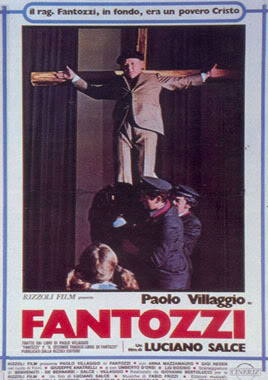
Before becoming an actor, Villaggio had been a modest office clerk in a metallurgical firm. It was from this experience that he drew the portrait of a shy, frustrated office clerk full of complexes, constantly mistreated by his superiors and mocked by his colleages: the book-keeper FANTOZZI. This was the name of a humorous novel with which he made his debut as a writer and which was an immediate best-seller. The neurotic Fantozzi, who creates troubles and calamities wherever he goes, becomes the vehicle for bringing to the screen the world of big business with a stinging satire that never misses the mark. FANTOZZI was made into a film in 1975 by Luciano Salce, on a script written by Villaggio himself with Benvenuti, De Bernardi and Salce. As an actor, Villaggio was the ideal interpreter of his literary creation, and whoever had seen him in his conventional aggressive and polemical stance could not fail to admire the way he succeeded in getting inside this pathetic figure of the born loser. Salce and Villaggio had the courage not to surround him with the usual "sex-bunnies" but with two character actresses from the theater who were full of satirical "bite", Anna Mazzamauro, the office colleague, and Liu Bosisio, the wife. Equally amusing results - also in book form - were obtained by the ensuing IL SECONDO TRAGICO FANTOZZI (THE SECOND TRAGIC FANTOZZI: 1976), directed again by Salce with the same principal actors. Villaggio went on to play similar roles in two other Salce films, IL...BELPAESE (THE FAIR LAND: 1977), written by Villaggio with the director and with Castellano and Pipolo, and RAG. ARTURO DE FANTI, BANCARIO PRECARIO (ACCOUNTANT ARTURO DE FANTI, TEMPORARY BANK CLERK: 1980).

Wednesday, November 30, 2011

9. Ugo Tognazzi: From the Farce To the Comedy of Manners part two

From: COMEDY ITALIAN STYLE

by Ernesto G. Laura

He could have gone on like that for who knows how long without the film that established him as a complete actor: IL FEDERALE (THE FEDERALIST), directed by Luciano Salce in 1961 and written by him with Castellano and Pipolo. In 1944, in Nazi-occupied Rome, Primo Arcovazzi is a modest non-com in the Black Brigades, a Fascist ingenuosly confident of the "certain victory," zealous and unquestionably a little stupid, who is given the assignment of going to the Abruzzi and arresting and bringing to Rome a distinguished anti-Fascist university professor whom the democrats plan upon making the President of The Republic, once Italy is liberated. Arcovazzi rides off in a motorcycle with sidecar, no automobile being available in those difficult times, and amidst endless vicissitudes returns with the prisoner. Except that the Allies have meanwhile reached Rome and Arcovazzi, who is traveling in a Mussolini black shirt, risks ending up in front of a firing squad; it is the professor who saves his life. The "gimmick" of the comedy is in bringing face to face two opposite mentalities, that of the dim-witted Fascist, who believes in all the slogans of the regime, and that of a liberal intellectual, wise and tolerant, who without ever pinning him to the wall, leads him little by little to understand certain things, to open his mind to a more responsible and critical evaluation of what is going on. In other words, a dialogue on the values of democracy and freedom, carried on in the midst of a hundred incidents and the risk of an active war. Though his partner was an illustrious name in the French cinema and theater like Georges Wilson, Tognazzi succeeded in emerging, drawing an exhilirating but penetrating portrait of his dull-headed Fascist.

In 1962, Luciano Salce would again lead him into the terrain of comedy with LA VOGLIA MATTA (THE MAD DESIRE), based on a short story by Enrico La Stella. Tognazzi's Berlinghieri is a character that would also be found in other films, the middle-aged man who falls madly in love with a much younger girl. Scintillating and gay, the film contains sudden turns of bitterness: Berlinghieri and Francesca do not succeed in overcoming the difference in age and their affair comes to an abrupt end. Tognazzi's third important collaboration with Salce (and the script-writers Castellano and Pipolo) was in 1963 with LE ORE DELL'AMORE (THE HOURS OF LOVE), a pungent, ironical, analysis, with some dramatic moments, of the crisis of a couple after marriage has legalized a long affair: they will go back to loving each other only when they are no longer husband and wife (the same theme, viewed from a completely different angle, of Ingmar Bergman's SCENES OF A WEDDING).

Thursday, November 3, 2011

7. Alberto Sordi Personification of the Average Italian part ten

From: COMEDY ITALIAN STYLE

by Ernesto G. Laura

As a director, Sordi then decided to bring his run-of-the-mill Italian "personage" into contact with great historical events in POLVERE DI STELLE (STAR DUST), written with Bernardino Zapponi and Ruggero Maccari on a story by the latter. The agonizing period, 1943/44, between the fall of Fascism, the armistice and the division of Italy in two, the Germans on one side, the Allies on the other, is recounted through the eyes of a second-rate vaudeville team, Mimmo and Dea (Sordi and Monica Vitti). The armistice takes them by surprise in a small Abruzzi town, at night they run into the car of the fleeing King on the road to Pescara, are embarked by the Fascists and carried to Venice, where Mussolini's republic has concentrated the world of show business, manage to escape and make their way to liberated Bari. Here, an audience craving entertainment after all the hardships endured cheers and applauds them, the only vaudeville company around (the important ones have remained in Rome or are in the North), and leads an impresario to organize a big musical revue all for them in the most important theater in town. After years of hunger and humiliation, success is theirs. But whell all of Italy is liberated and the true glories of the music hall return to Bari, nothing remains for Mimmo and Dea but to go back to the small-time suburban houses, to the dreary life of before. Perhaps a little too long, POLVERE DI STELLE (STAR DUST) is an amusing and at the same time touching description of an epoch, where the grotesque is always used with unfailing subtlety.

In any case, Sordi's best film as a director is FINCHE C'E GUERRA C'E SPERANZA (AS LONG AS THERE'S WAR THERE'S HOPE: 1974), written with Leo Benvenuti and Pietro De Bernardi, where, with a critical relentlessness that gradually shifts the film from the satirical tone of the beginning to the bitterly dramatic tone of the ending, he describes the cynical personality of an arms dealer, Pietro Chiocca, who moves from one African county to the other, exploiting the tensions and conflicts between recently independent states as a way of making money, selling arms indifferently to both sides. When his family, influenced by a newspaper campaign, turns against him, Pietro shoulders them with their responsibilities: they have accepted the prosperity, indeed the wealth that dirty work has made possible and which they are not about to give up.

To complete the picture of Sordi's contribution to comedy as civil satire, two films based on the sanitary system and on the figure of the doctor must be mentioned: IL MEDICO DELLA MUTUA (THE WELFARE MEDIC: 1968) by Luigi Zampa, based on the novel by Giuseppe D'Agata with a script by Amidei, Sordi and Zampa, draws the malicious portrait of a dishonest doctor, Dr. Terzilli, who cures his patients hastily and sometimes even only by phone in order to accumulate a large number of patients and hence higher fees from the welfare state. The following year, the same character returned in IL PROF. DOTT. GUIDO TERZILLI, PRIMARIO DELLA CLINICA VILLA CELESTE CONVENZIONATA CON LE MUTUE (DR. GUIDO TERZILLI, CHIEF PHYSICIAN OF THE VILLA CELESTE CLINIC, APPROVED BY THE PUBLICH HEALTH SERVICE), directed by Luciano Salce and also written by Amidei and Sordi (with the director). The satirical darts of the first film are slightly blunted, because they are predictable, in this second film, which follows the doctor in his increasingly more successful career, until he transforms his clinic into a rest-home for rich old ladies.

UN BORGHESE PICCOLO PICCOLO (A PETTY PETTY BOURGEOIS: 1977) by Mario Monicelli, from the novel by Vincenzo Cerami, does not, strictly speaking, pertain to the comedy genre, indeed in the whole second part it is a gloomy tragic film. It is worth mentioning, however, for the way both the director and the actor succeed, as is typical of comedy, in starting off on a light tone, with various decidedly comic situations (for example, a secret meeting of initiation into a Massonic lodge), and from there to proceed through ever more crucial turnings of the screw to the unrelenting brutality of the final images. In 1979, lastly, he confronted one of the theater classics of all times, Moliere, in the film version of IL MALATO IMMAGINARIO (LE MALADE IMMAGINAIRE/THE HYPOCHONDRIAC), directed by Tonino Cervi, with the action shifted to 18th century Rome, still the capital of the Papal States. Though the adaptation is questionable and certain references to modern-day terrorism seem strained, Sordi's performance is outstanding, pervaded even, as it is, by a certain Pirandello flavor, by virtue of which his Argante, beneath the appearance of a weak and cowardly man who locks himself into the house, frightened by everything, is a lucid critic of the ills of society.