Showing posts with label Federico Fellini. Show all posts

Wednesday, February 1, 2012

13. The "Second Wave" of Comedy Actors part ten

From: COMEDY ITALIAN STYLE
by Ernesto G. Laura
Other actors, some of them international stars, have not been taken into detailed consideration here because their comedy appearances fall into a larger and more complex framework of motion picture activities. Such is the case with Marcello Mastroianni and Monica Vitti. Both have important dramatic interpretations to their credit: suffice it to remember Michelangelo Antonioni's LA NOTTE (NIGHT), in which they appeared together. As to Mastroianni, mention must be made of the Fellini films, from LA DOLCE VITA (THE SWEET LIFE) to LA CITTA DELLA DONNE (CITY OF WOMEN), as to Vitti those of Antonioni, from L'AVVENTURA (THE ADVENTURE) to IL MISTERIO DI OBERWALD (THE MYSTERY OF OBERWALD). Even so, the former's natural inclination to irony, the latter's to caricature, often made it possible to introduce moments of genuine humor into dramatic films.
In the 1950s, Marcello Mastroianni was often one of the young leads in the humorous-sentimental comedies that were in fashion. He then reappears in Ferreri's LA GRANDE ABBUFFATA (THE BIG FEED) and in many more recent comedies (among other things, he starred in the musical comedy, VALENTINO, where in the role of the famous silent film star he danced and sang).
Monica Vitti, instead, appeared more regularly in the film comedy genre. Indeed, several films were made especially to show off her particular whimsical personality. For example, the movie versions of several successful stage works: TI HO SPOSATO PER ALLEGRIA (I MARRIED YOU OUT OF MIRTH: 1967) by Luciano Salce, on the play by Natalia Ginzburg, with Giorgio Albertazzi and Maria Grazia Buccella, L'ANATRA ALL'ARANCIA (DUCK A L'ORANGE: 1975), it too by Salce, from the play by Home and Sauvajon, adapted to the screen by Bernardino Zapponi, with Ugo Tognazzi, John Richardson and Barbara Bouchet, AMORI MIEI (MY DARLINGS: 1978) by Steno, from the play by Jaja Fiastri, with Dorelli and Enrico Maria Salerno, NON TI CONOSCO PIU AMORE (DON'T KNOW YOU ANYMORE, DARLING: 1980) by Corbucci, from an old play by Aldo De Benedetti which had already been made into a film in 1936 at the time of the "white telephone" comedies. The film which revealed most completely the gifts of Monica Vitti, a modern actress who even so identifies herself with the character emotionally, from within, was LA RAGAZZA CON LA PISTOLA (THE GIRL WITH THE PISTOL), directed in 1968 by Mario Monicelli from a story by Sonego adapted to the screen by Sonego and Magni. She is a farm girl from a small Southern town with a very closed mentality, who is "dishonored" by a local boy and goes looking for him in America to kill him and "wash away the disgrace," imagining at every stage of the journey the different ways the execution will take place. Vitti is extraordinary in depicting the various stages in the evolution of the girl, who, as the journey proceeds and she gains new experience, gradually begins to feel less and less disposed to carry out the ritual murder, more a woman, more modern, more mature.

Wednesday, January 18, 2012

13. The "Second Wave" of Comedy Actors part three

From: COMEDY ITALIAN STYLE

by Ernesto G. Laura

As to Adriano Celentano (Milanese like Dorelli and a year younger, having been born in 1938) success in films also came some time after his professional debut. In the beginning, Celetano made a name for himself in dance halls and vaudeville theaters as an imitator of Jerry Lewis. Between the late '50s and early '60s, Italian pop music underwent a deep change, leaving behind the tuneful sentimental ballads it had thrived on for decades and embracing the new phenomenon of "cantautori", that is of singers who wrote their own songs, using a more essential and direct language, music in which the guitar was preferred over the big bands of yesterday, a sharp, pounding beat that led the new pop stars to be known as "howlers". Celentano, abandoning imitations, soon revealed a dynamic, outgoing vulcanic personality. He appeared briefly as a night club singer in Fellini's LA DOLCE VITA (THE SWEET LIFE: 1959), then carried on with a not particularly outstanding film career for several years, as his popularity grew in the field of television, pop concerts and records.

Meanwhile, imitating Sinatra, he formed the "Adriano Celetano Clan", consisting of singers, musicians, arrangers who since then have worked permanently for him. In 1968, Pietro Germi, as mentioned above in the chapter devoted to him, insisted upon having Celentano for the title role in SERAFINO, a rustic peasant comedy. In 1971, Alberto Lattuada starred him in BIANCO, ROSSO E... (WHITE, RED AND...) with Sophia Loren. In RUGANTINO (1973) by Pasquale Festa Campanile, he brought to the screen the musical comedy that Nino Manfredi had appeared in on stage.

Tuesday, October 18, 2011

7. Alberto Sordi Personification of the Average Italian part three

From: COMEDY ITALIAN STYLE

by Ernesto G. Laura

It is, however, a short episode in the film UN GIORNO IN PRETURA (A DAY IN COURT: 1954), by Steno, which brought Sordi the wild-spread popularity he still enjoys. When he appears in an undershirt at the back of the courtroom where he is on trial for having swum naked in the river and says, as if presenting his calling card: "Indecent conduct, Mr. Judge, indecent conduct," a character is born and fills the screen: Nando Moriconi, the "Americano". He is a boy from the working-class suburbs, illiterate and maybe a little stupid, who has assimilated the "American way of life" from films and newspapers, speaks in a funny way that is meant to be Anglo-Saxon but immediately switches to Roman dialect and dreams of skyscrapers, gunmen, the Far West, gangsters, cops, everything that reaches him from American films. The story concerning him - he went swimming in the river and some urchins steal his clothes, so he is forced to go home naked - is little more than an anecdote, a filmed joke, but Nando Moriconi is a figure out of the ordinary who excites both laughter and tenderness in his gentle meglomaniac folly. The figure would return immediately after in UN AMERICANO A ROMA (AN AMERICAN IN ROME: 1954), again by Steno, in a film all for him and with a script in which Ettore Scola also had a hand. It's a sort of biography of Nando Moriconi, an unsuccessful vaudeville dancer with the state name (Americanized, of course) of Santee Baylor, from the time of the Nazi occupation to the post-war period, in a crescendo of disasters brought on by his mania for dressing up, among other things, as an American cop. Twenty years later, Nando Moriconi would be "fished out" again for an episode in the film DI CHE SEGNO SEI? (WHAT'S YOUR SIGN: 1975) by Sergio Corbucci, in which the one-time youngster, now a grown-up man but still a "big baby" in spirit, crowns his American dream with a uniform and a motorcycle like the ones used by American cops, hired as a private bodyguard to protect a rich tycoon frightened of terrorists.

Sordi, born in the famous Trastevere quarter of Rome, is ideally suited to playing the "Roman of Rome" in the spirit of popular humor, drawing upon his personal experiences to invent typical Roman "characters". In GUARDIA, GUARDIA SCELTA, BRIGADIERE E MARESCIALLO (PRIVATE, PRIVATE FIRST-CLASS, CORPORAL AND SERGEANT), directed in 1956 by Mauro Bolognini (and written by Maccari, Scola and Manzari on a story by Paolo Frasca) he incarnates, very realistically with only a few, essential comic touches, the part of a policeman who plays in the Police Department Band and studies French with the secret ambition of becoming an interpreter. In LADRO LUI, LADRA LEI (HE THIEF, SHE THIEF: 1954) by Luigi Zampa (written by Franciosa and Festa Campanile, Zampa and Sordi) he is Cencio, a small0time professional thief by age-old family tradition, who from childhood and with unshakable optimism alternates periods in jail and periods of freedom. In FORTUNELLA, directed in 1958 by Eduardo De Filippo, but on an idea by Fellini, he is a modest secondhand dealer who is actualloy a "fence" and who does not hesitate to send his mistress to jail in his place (those negative heroes begin to appear which Sordi took up from time to time with no fear of diminishing his popularity). He plays a similar role in NELLA CITTA L'INFERNO (HELL IN THE CITY: 1959) by Renato Castellani, where he is Adone, the boy-friend of a housemaid who ends up in jail for a robbery organized by him. COSTA AZZURRA (RIVIERA: 1959) by Vittorio Sala finds him in the role of a fruit-seller momentarily carried away by the mirage of becoming a movie star. IL VIGILE (THE POLICEMAN: 1960) by Luigi Zampa presents him as a jobless man of no great intelligence, Otello, who as the result of a recommendation becomes a policeman and learns at his own expense, having attacked the mayor of the city, that to get along in the world you have to wait upon the powerful. So he lets the mayor drive his fast car into a street where it is prohibited to go and now the mayor, how had insisted upon being let by, ends up in a ditch.

In LO SCOPONE SCIENTIFICO (THE CARD GAME), written by Rodolfo Sonego and directed by Luigi Comencini, he is "borgataro" (a man from the working-class suburbs) who every year, during the holiday and tourist season, is called by an eccentric old American millionairess who lends him a million to play cards ("scopone scientifico," a sort of cassino) against her, certain that in the end she will win it all back. This bitter and paradoxical story, ending on an unexpected note of black humor, derives much of its comic flavor from the contrast between two actors as different in style and tradition as Alberto Sordi and Bette Davis.

Monday, October 17, 2011

7. Alberto Sordi Personification of the Average Italian part two

From: COMEDY ITALIAN STYLE

by Ernesto G. Laura


MAMMA MIA, CHE IMPRESSIONE! (DEAR ME, WHAT A FRIGHT!: 1951) by Roberto Savarese (with the supervision of Vittorio De Sica) was produced by a company especially set up by De Sica and Sordi. The story was by Sordi himself, who also wrote the script with De Sica and Zavattini, showing right from the start a firm determination not to be a mere performer but to take an active part in the creation of the film. He played the role of a doltish, simple-minded boy scout, with a certain flair for parody, but the film on the whole was second-rate and had no success at the boxoffice.

He owed his success, as said above, to Fellini's I VITELLONI (THE YOUNG STEERS), presented and awarded a prize at Venice in 1953. Fellini had, however, already established his particular world with LO SCEICCO BIANCO (THE WHITE SHEIK) in 1952, written by Tullio Pinelli and Ennio Flaiano and based on a story that Michelangelo Antonioni also had a hand in. It told of a couple of petty bourgeois newly-weds, very respectable, very careful of appearances, who come to Rome from the South on their honeymoon, which includes a visit to the Pope. Vanda, the newly-wed wife, is a rabid reader of picture-story magazines (which grew up in Italy and were enormously popular in the '50s, mostly with women). Vanda takes advantage of the trip to Rome to make the acquaintance of a picture-story star, the daring young man who plays the lead in the story of the "White Sheik". The encounter was to be very disappointing, as Fernando Rivoli, the "White Sheik", is an uncouth, sly and cynical character, deceitful and promiscuous, exactly the opposite of the "unblemished hero" she had dreamt of. What emerges in the film is that idea of the Italian provinces as the begetter of myths, of dreams (and frustrations) that was to return as a constant refrain in the director's films. But the Sordi "personage" also emerges fully drawn, part cad, part show-off and part "big baby".

In I VITELLONI (THE YOUNG STEERS: 1953), where the Rimini of Fellini's boyhood serves as background, the director follows a group of friends about to turn thirty, when the carefree years of youth are coming to an end. But they refuse to grow up, are against working or getting married and would like nothing better than to idle away their time as eternal students. Life would bring them, one by one, face to face with their responsibilities. Alberto, in particular, coming home from a Mardi Gras party where he has had a wild time dressed as a woman, finds his mother in tears because his sister has run off with a man, forever. He, who has always led an idle life at his sister's expense, suddenly has to become a man.

Friday, October 14, 2011

7. Alberto Sordi Personification of the Average Italian part one

From: COMEDY ITALIAN STYLE

by Ernesto G. Laura


Alberto Sordi was born in 1920, started working in films in small parts as early as 1937, yet it wasn't until 1951 that someone gave him the lead in a film (MAMMA MIA, CHE IMPRESSIONE! - DEAR ME, WHAT A FRIGHT!), though it didn't open many doors for him until a year later when a director making his first film, Federico Fellini, had to fight with the producer to get Sordi for LO SCEICCO BIANCO (THE WHITE SHEIK). Unfortunately, Fellini's "opus one" was a complete flop, but when he made I VITELLONI (THE YOUNG STEERS) he insisted upon having Sordi for one of the leading roles. Success at last, both for the director and the actor, who managed to stand out in a film on a par with lots of able young actors (Franco Interlenghi, Leopoldo Tireste, Franco Fabrizi). A little later, an episode in the film UN GIORNO IN PRETURA (A DAY IN COURT) sketched out the specific contours of his personage, bringing him an enormous popularity.

Yet if one looks at the twenty or so films he made before then, the talent of the actor was already fully apparent; suffice it to remember the go-getting clerk in LE MISERIE DEL SIGNOR TRAVET (THE MISFORTUNES OF SIGNOR TRAVET: 1946) by Mario Soldati or the sinister individual in SOTTO IL SOLE DI ROMA (UNDER THE SUN OF ROME: 1948).

Why then did an expert actor have to wait some fifteen years in order to "make it"? The reason probably lies in the fact that he had not yet discovered his "personage" and his performances, however excellent, did not bring into focus a recognizable moral and psychological individuality, an "identity". He started his career, for example, under the wing of Oliver Hardy, when in 1937 he won the contest organized by Metro-Goldwyn-Mayer for the voice best suited to dubbing in Italian the voice of the partner of Stan Laurel. Laurel and Hardy were - and still are, thanks to television - highly popular in Italy. Sordi was able to gain access to the vaudeville stage precisely because he was presented as "the Italian voice of Oliver Hardy", whom he then went on to imitate. Breaking away from that model, he did a little of everything in the theater, capable, well-liked, but never really a celebrity. Since he was young and good-looking, during the war he accidentally co-starred in a heroic air-force film, I TRE AQUILOTTI (THE THREE YOUNG EAGLES: 1942) by Mario Mattoli, on a story by Vittorio Mussolini, the "Duce's" son. It was a completely "serious" role, which shows that producers had not recognized the actor's real talents.

These talents gradually came to the fore, thanks to the radio. In his search for an "identity", he even went so far as to try success as a radio singer. But it was most of all with certain characters ("Signore Dice", "Count Claro", "Mario Pio", "the parish buddies") that the artistic individuality of Alberto Sordi irresistibly began to take shape: on the one hand, the big grown-up baby, on the other the saucy, aggressive wise guy. It would be the sum total of these two characters, which were poles apart, that would go to form the unique "personage" Sordi brought to the screen: a cocky young man, meddlesome, aggressive, who suddenly reveals unexpected reserves of immaturity, certain childish characteristics which offer a fertile terrain for his comic streak.

Wednesday, September 21, 2011

5. The Episode Films part nine

From: COMEDY ITALIAN STYLE

by Ernesto G. Laura - Compiled by A.N.I.C.A. (National Association of Motion Pictures and Affiliated Industries) Rome, Italy - Edited by CIES Soc. Coop. r.1 (Institute for the Promotion of Italian Motion Pictures Abroad) Rome, Italy under the auspices of the Ministry of Tourism and Entertainment


SIAMO DONNE (WE'RE WOMEN), made in 1953, represented the second experiment suggested by Zavattini. The idea was to bring to the screen the private, lesser known dimension of four famous movie stars, revealing their hidden natures. It began as a sort of "cinema-verite" on the screen tests of unknown actresses to find new faces for the movies and then wound up getting personal confessions out of Ingrid Bergman, Isa Miranda, Alida Valli and Anna Magnani. Here too the results were far different from the premises: the four episodes ended up as distinct, well-constructed stories, which had nothing of the spontaneous and indiscreet confessions of the original plan. Particularly worthy of note, with its pungent satire of wartime Rome, the episode in which Anna Magnani gets into a quarrel with a cab-driver that keeps getting more and more people involved. The director was Luchino Visconti.

In 1959, Fellini's LA DOLCE VITA (THE SWEET LIFE) was essentially an episode film with an evident inner unity. A couple of years later, the director answered the attacks launched by certain moralists against his film with the episode, Le tentazioni del dottor Antonio (The Temptations of Dr. Antonio), included in BOCCACCIO '70. Peppino De Filippo was the stern defender of morals who unleashes a campaign against an immense billboard advertisement showing a sexy Anita Ekberg in the same low-cut evening dress she wore in the famous Fontana di Trevi sequence of LA DOLCE VITA. At night, however, Anita comes down from the billboard, becomes flesh and blood and pursues her accuser who ends up in an insane asylum. Aside from the above-mentioned La riffa (The Raffle) by De Sica, the rest of the film consisted of Renzo e Luciana (Renzo and Luciana) by Mario Monicelli, written by Suso Cecchi D'Amico, the director and two first-rate writers like Giovanni Arpino and Italo Calvino, which criticized with apparent charm, but underlying harshness, the <> of industrial society which prevents a couple of newly-weds from living the intimacy of their marriage in peace, and Il lavoro (The Job), by Visconti, a rather "nasty" comedy of manners about a wife who, to get even with her husband who has been unfaithful to her with a prostitute, puts a fee on her own "services".

Friday, September 16, 2011

5. The Episode Films part eight

From: COMEDY ITALIAN STYLE

by Ernesto G. Laura - Compiled by A.N.I.C.A. (National Association of Motion Pictures and Affiliated Industries) Rome, Italy - Edited by CIES Soc. Coop. r.1 (Institute for the Promotion of Italian Motion Pictures Abroad) Rome, Italy under the auspices of the Ministry of Tourism and Entertainment

Cesare Zavattini, that motivating force in all seasons of new ideas for the Italian cinema, tried to exploit the formula of the episode film for several films half-way between the inquiry and the documentary. AMORE IN CITTA (LOVE IN THE CITY) was the first in a series and the intention of continuing it was apparent in the sub-title, Rivisita cinematografica n. 1 (Film Review No. 1). Taking the common theme of love in its various accepted meanings and nuances, a group of new directors was supposed to "explore" the emotions of a city, Rome of course. What happened instead was that each one went his seperate way, some undertaking an authentic inquiry, others telling a completely invented story, still others simply going through the streets armed with a motion-picture camera. The latter was the case with Alberto Lattuada in the episode Gli Italiani si voltano (Italians Turn To Look), a sort of "cinema-verite" exercise which catches the reactions of Roman males when a beautiful girl passes by. Un'agenzi matrimoniale (A Matrimonial Agency), an episode entirely constructed in the studio with unknown actors, was a "fake inquiry" conducted by Federico Fellini in the sad, shoddy world of those agencies which arrange (or try to arrange) marriages between shy and lonely people. This is the first indication of that "fictional" cinema, with the appearances of a documentary, that Fellini would later develop in I CLOWNS (THE CLOWNS), ROMA (ROME) and PROVA D'ORCHESTRA (ORCHESTRA REHEARSAL). But the best episode was Paradiso per quattro ore (Paradise For Four Hours) which revealed the talents of Dino Risi as a fond and ironic observer of the common people who spend their Saturdays at a "balera" (a popular dance hall which has nothing to do with the luxury of a night club or the rowdy modernity of the discotheque).

Wednesday, June 29, 2011

2. The Forties: The Season Of Neo-Realism part three

From: COMEDY ITALIAN STYLE

by Ernesto G. Laura - Compiled by A.N.I.C.A. (National Association of Motion Pictures and Affiliated Industries) Rome, Italy - Edited by CIES Soc. Coop. r.1 (Institute for the Promotion of Italian Motion Pictures Abroad) Rome, Italy under the auspices of the Ministry of Tourism and Entertainment


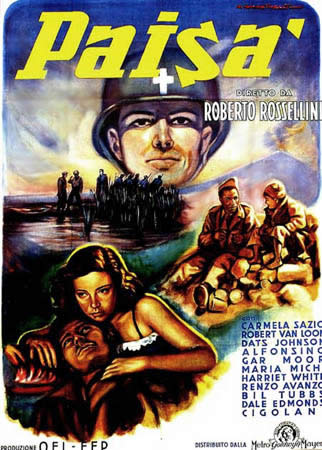
Roberto Rossellini's other classical film on the Resistance is PAISA (1947). Here echoes from the cinema of the past fuse with certain important premises for the development of the cinema of the future. The film is divided into episodes, that is a kind of film rarely exploited in Italy (only two titles come to mind: QUARTA PAGINA [FOURTH PAGE] by Nicola Manzari in 1943 and CIRCO EQUESTRE ZA-BUM [ZA-BUM CIRCUS] by Mario Mattoli in 1944) and ventured with some success only by Hollywood (IF I HAD A MILLION, 1932) and the French (CARNET DU BAL, DERRIERE LA FACADE, PARADE EN SEPT NUITS). Episode films were frequently nothing more than a random collection of short stories. Rossellini, instead, linked each episode to the others: the film as a whole, paints the historical picture of the Allied advance in Italy from the landing in Sicily in June, 1943, to the liberation of the North in 1945. The first and last of the short episodes are starkly tragic, fraught with death. In between, however, the director and his associates alternate humor and drama. See, for example, the two completely comic episodes about Naples (the friendship between a black American soldier and a Neapolitan "sciuscia" of bootblack) and the Romagna (the quandry of a convent of Catholic friars forced to take in two American chaplains of a different religion). Also in PAISA, written mostly, like ROMA, CITTA APERTA [ROME, OPEN CITY], by Sergio Amidei, the humorous touch of Fellini can be detected.

Friday, June 24, 2011

2. The Forties: The Season Of Neo-Realism part two

From: COMEDY ITALIAN STYLE
by Ernesto G. Laura - Compiled by A.N.I.C.A. (National Association of Motion Pictures and Affiliated Industries) Rome, Italy - Edited by CIES Soc. Coop. r.1 (Institute for the Promotion of Italian Motion Pictures Abroad) Rome, Italy under the auspices of the Ministry of Tourism and Entertainment

Even so, as has now been made perfectly clear, Italian cinema cannot historically be divided into two neat division: Fascist-period films on the one side, neo-realism on the other. Many elements of the way films were made before were carried over into the post-war period, even in important works, if for no other reason that the artistic and technical personnel had remained pretty much the same. So it is easy to understand how, in an essentially dramatic and, indeed, tragic genre like neo-realism, the ingredients of comedy were not altogether lacking.

Take ROMA, CITTA APERTA [ROME, OPEN CITY], directed in 1945 by Roberto Rossellini (1906-1977). The great director manages to create a manifold image of a luminous city suddenly plunged into gloom by the Nazi occupation and the deplorable phenomenon of collaborationism. Rossellini shoots on the street, recreating, where it actually took place, a tragedy experienced barely yesterday, the scars of which are still painfully fresh in people's minds. He takes as a point of reference a parish priest, Don Morosini (the story is true), and the mother of a family who sees her man arrested and then tortured to death. Two characters meant to be the exact opposite of the "heros" of the traditional epic cinema and who could never be played by two "cute and glamorous" matinee idols, according to the rules of the star system. So Rossellini chose Aldo Fabrizi and Anna Magnani, the couple of CAMPO DE' FIORI and L'ULTIMA CARROZZELLA [THE LAST CARRIAGE], and carried their usual roles as popular comedy figures up and up, without a hitch, to the heights of tragedy. ROMA, CITTA APERTA [ROME, OPEN CITY] could not have existed without the triptych of comedies which Fabrizi and Magnani had previously appeared in. It was those films that got audiences used to leading actors who were neither glamorous, nor very young, to films shot outside, in the open, with real people, to the use of Roman dialect instead of the polished Italian of the professional actors. To be sure, ROMA, CITTA APERTA [ROME, OPEN CITY] is a masterpiece and the three films that preceded it were, instead, made for sheer entertainment, but the connecting thread between them is clear. Not only, but the presence among the script-writers of the same Federico Fellini of those films made it certain that the material of ROMA, CITTA APERTA [ROME, OPEN CITY] would be "alleviated" from time to time by a few light, but essential humorous touches.

Wednesday, June 22, 2011

1. The Thirties: The Age of the "White Telephones" part nine

From: COMEDY ITALIAN STYLE
by Ernesto G. Laura - Compiled by A.N.I.C.A. (National Association of Motion Pictures and Affiliated Industries) Rome, Italy - Edited by CIES Soc. Coop. r.1 (Institute for the Promotion of Italian Motion Pictures Abroad) Rome, Italy under the auspices of the Ministry of Tourism and Entertainment


Among the various regional and dialectal theatrical traditions, little space was occupied by the Roman dialect theater, despite the presence of an extraordinary actor like Ettore Petrolini. Roman dialect flourished, not so much in the "respectable" theaters, as on the shoddy stages of secondrate vaudeville houses, which were mostly located in the poorer parts of town with a decidedly working-class audience. One of the lesser celebrities of those theaters was Aldo Fabrizi (born in 1906), comedian, poet, entertainer of enormous appeal with his round face, his plump body and a deliberately unconventional way of speaking, that is with the words almost "eaten" to give the impression of words being made up on the spot rather than memorized beforehand. A former silent movie star who had taken up directing with some success, Mario Bonnard (1889-1965) put Fabrizi, then unknown in movies, into the leading role of AVANTI C'E POSTO... [COME ON, THERE'S ROME...: 1942]. On stage, the actor had created, with a fine sense of parody, a number of typical Roman characters, including a streetcar conductor. It was this figure which was placed at the center of a story that recaptures the humorous, sentimental flavor of Camerini's comedies in telling of the bashful courtship a middle-aged streetcar conductor pays to a pretty young house maid who is out of a job, until he realizes that the girl is in love with a young colleague of his. The story, written by Zavattini, Fabrizi and Piero Tellini, is weak, but it is the way it is told that matters. Between romantic scenes and scintillating gags, a quite accurate picture of wartime Rome emerges and the film ends sadly with the young husband-to-be leaving for the front of an already lost war. Federico Fellini also lent a hand to the script and certain gags are typically his. Immediately after, Mario Bonnard, director; Fellini, Fabrizi, Tellini, scriptwriters; Marino Girolami, scenarist, came up with CAMPO DE' FIORI (1943), where Aldo Fabrizi plays the part of a fishmonger who has a stormy love affair with a woman who sells fruit and vegetables in the popular open-air market of Campo de' Fiori, one of the most picturesque squares in Rome. The woman was Anna Magnani, till then known as a variety show star with Toto and in films in the type-cast role of a coarse woman of dubious reputation. CAMPO DE' FIORI completely overhauled the image of Anna Magnani, turning her into a positive figure: a simple woman of the people, all heart and instinct, brusque and aggressive in manner. A love affair between two actors no longer very young (Fabrizi was thirty-seven, Magnani thirty-five) in lower-class roles was something new and the film took great delight in the lively imagery of the true-to-life streets and squares of Rome. The third and last film of the series was, again in 1943, L'ULTIMA CARROZZELLA [THE LAST CARRIAGE], directed by Mario Mattoli and written by Fabrizi and Fellini, the story of a Roman carriage driver, galled by the competition of taxis, who forbids his daughter to marry a taxi driver. This then completes the triptych which brought to the screen a bittersweet image of "popular" Rome, of simple people who live modestly off their earnings in a city caught in the transition between an old world that would be swept away by the war, and a new world that could yet barely be glimpsed. Meanwhile, as the historic tragedy of Italy ran its course, comedy pointed in the direction of human solidarity and understanding with a certain hope for the future.