Showing posts with label Pietro Germi. Show all posts

Wednesday, January 18, 2012

13. The "Second Wave" of Comedy Actors part three

From: COMEDY ITALIAN STYLE

by Ernesto G. Laura

As to Adriano Celentano (Milanese like Dorelli and a year younger, having been born in 1938) success in films also came some time after his professional debut. In the beginning, Celetano made a name for himself in dance halls and vaudeville theaters as an imitator of Jerry Lewis. Between the late '50s and early '60s, Italian pop music underwent a deep change, leaving behind the tuneful sentimental ballads it had thrived on for decades and embracing the new phenomenon of "cantautori", that is of singers who wrote their own songs, using a more essential and direct language, music in which the guitar was preferred over the big bands of yesterday, a sharp, pounding beat that led the new pop stars to be known as "howlers". Celentano, abandoning imitations, soon revealed a dynamic, outgoing vulcanic personality. He appeared briefly as a night club singer in Fellini's LA DOLCE VITA (THE SWEET LIFE: 1959), then carried on with a not particularly outstanding film career for several years, as his popularity grew in the field of television, pop concerts and records.

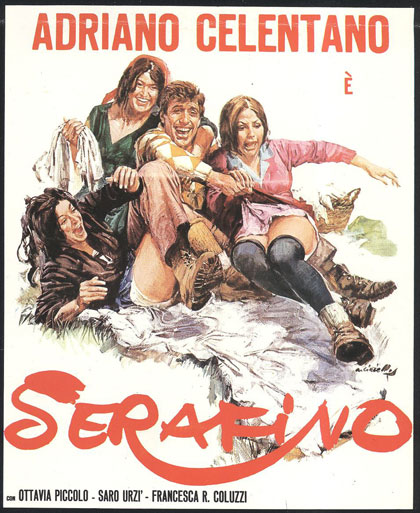
Meanwhile, imitating Sinatra, he formed the "Adriano Celetano Clan", consisting of singers, musicians, arrangers who since then have worked permanently for him. In 1968, Pietro Germi, as mentioned above in the chapter devoted to him, insisted upon having Celentano for the title role in SERAFINO, a rustic peasant comedy. In 1971, Alberto Lattuada starred him in BIANCO, ROSSO E... (WHITE, RED AND...) with Sophia Loren. In RUGANTINO (1973) by Pasquale Festa Campanile, he brought to the screen the musical comedy that Nino Manfredi had appeared in on stage.

Friday, January 13, 2012

12. Pietro Germi Vs. Moralism part four

From: COMEDY ITALIAN STYLE

by Ernesto G. Laura

The director returns to a popular world in SERAFINO, which is 1966 won first prize (ex-aequo) at the Moscow Film Festival. On a script written by Giovannetti, Benvenuti, De Bernardi and Pinelli, Germi tells a story about a small Ciociaro town of farmers and shepherds, cut off from the modern world. Most of all it is the portrait of Serafino, a country yokel, lumpish and uncouth but good at heart and very asute, who manages to extricate himself, amidst swindlers and swellheads, and to get along with unruffled serenity, veritable symbol of the pure, unspoiled popular soul. By no accident, of the people around him the only figure who is to a certain extent lovable and positive is Asmara, a young village prostitute, the mother of countless children (excellently portrayed by Francesca Romana Coluzzi). Of particular interest the dialogue, where for the first time slighting "bawdy" verbal expressions are used, typical of the way a peasant would speak. The film launched the acting career of a pop singer, Adriano Celetano, who will be further discussed in the last chapter, revealing in him outstanding qualities as a spontaneous and appealing actor.

At the time of his death, Germi was preparing AMICI MIEI (MY FRIENDS: 1975), which was then directed by Mario Monicelli with the utmost respect for the intentions and desires of the late director, so that while Monicelli appeared in the credit titles as the director, a notice was added with the words: "a film by Pietro Germi".

After Sicily, the Veneto and Lazio, now it was Tuscany which, from the time of Giovanni Boccaccio's classic novelle, has been the land of the practical joke, the sarcastic jibe, the sometimes even cruel prank. Five fifty-year old friends, distinguished professionals in life, are used to getting together from time to time to play sensational jokes in the most unimaginable places, often devised, planned, and carried out on a large scale. Life, however, cannot be brought to a halt byt his childish way of staying twenty when you are more than twice the age, and the death of one of them would end by giving them a glimpse of the bitter fact that the days of games and horseplay are over. Whimsical, bizarre, jocose, interrupted by frequent thrusts of grief and drama, AMICI MIEI (MY FRIENDS) blends the finest qualities of Germi and Monicelli in a satirical representation of penetrating depth. The five friends are Tognazzi, Philippe Noiret, Gastone Moschin, Adolfo Celi and Duilio Del Prete, while Bernard Blier plays the part of Righi, their chosen victim.

Thursday, January 12, 2012

12. Pietro Germi Vs. Moralism part three

From: COMEDY ITALIAN STYLE

by Ernesto G. Laura

In 1966, Germi won the Gold Palm (ex-aequo) at the Cannes festival with SIGNORE E SIGNORI (LADIES AND GENTLEMEN), in which he moves his criticism of manners to the Veneto bourgeoisie, using the town of Treviso as his geographical and social setting. Veneto writer Luciano Vincenzoni collaborated closely with the director on the story and script (Age and Scarpelli helped with the latter), fitting together a mosaic teeming with figures, large and small, of a colorful human "bestiary", caught in the merry-go-round of hypocrisy which Germi attacks with a firm polemical thrust. A multitude of well-known actors moves through the film, each given a space of his own: from Alberto Lionello to Olga Villi, from Gigi Ballista and Gaston Moschin to Virna Lisi and Franco Fabrizi.

One gets, even so, the impression that Germi didn't preserve on screen everything he had observed and that the film, however amusing and well-constructed and however skillful the dialogue, offers a less definitive picture of that bourgeois society than it could have been, sometimes bordering on the caricature sketch, which is something less than satire.

L'IMMORALE (THE IMMORALIST: 1967) was polemical, starting from the title itself. Instead of the analysis of a provincial society, as in his other two comedies, the director (with the collaboration on the script of Alfredo Giannetti, Tullio Pinelli and Carlo Bernari) pauses to shed light on the paradoxical situation of a single character, a violinist who, with a certain seriousness of his own, takes up with other women aside from his wife, ends up having three homes and three families, children included, and is forced to run from one train to another to keep his different wives happy and also wearing himself out from the fulfillment of his marriage "duties", until he dies from a heart attack. Germi doesn't pass judgment but is interested in exploring the soul of this man, who from the outside would seem to be a kind of playboy but is capable, instead, of a very special and sincere kind of loving of his own. Ugo Tognazzi was the violinist, Stefania Sandrelli, Renee Longarini and Maria Grazia Carmassi his three women.

Wednesday, January 11, 2012

12. Pietro Germi Vs. Moralism part two

From: COMEDY ITALIAN STYLE

by Ernesto G. Laura

DIVORZIO ALL'ITALIANA (DIVORCE, ITALIAN STYLE: 1961), awarded an Oscar in 1963 for the best original story and script (written by Ennio De Concini, Alfredo Giannetti and the director himself), takes Germi back to Sicily, not however the Sicily of the mafia but rather of the high land-owning aristocracy. Since at that time divorce didn't exist in Italy and local society would not have tolerated cohabitation, Baron Fefe, in order to marry his enticing little cousin, Angela, must first of all get rid of his wife. At first, he fondles various kinds of perfect crimes in his imagination, then as an expert connoisseur of the rigid moralistic mentality of his world, gets the idea for a highly unique "Italian-style divorce": force his wife to commit adultery, catch her redhanded and then he would be authorized, according to a certain article of the penal code, at that time still in force, to kill her "for reasons of honor". To be sure, he would spend a few years in prison, with all the comforts a rich man could afford, but thanks to "good conduct" he would soon be released and able to wed the charming Angela. The story unfolds, agile and amusing, linking together minor and major figures, people and geographical and social backgrounds. Marcello Mastroianni is an utterly absurd Fefe, indolent, sly, bored, without a job or a serious worry in the world, the prototype of an impoverished and effete aristocracy which Germi eyes with the maliciousness of great satire, just as the arm of satire serves him to attack those aspects of the penal code which to the modern conscience seemed more than out-of-date.

Moral outrage was the mainspring of the director's second comedy of manners set in Sicily: SEDOTTA E ABBANDONATA (SEDUCED AND ABANDONED: 1964), written by Germi with Luchino Vincenzoni, Age and Scarpelli and centered entirely around the agitated figure of Vincenzo Ascalone, the father of family who even on his death bed is obsessed with defending the "family honor". A much more mature work than the previous one, with characters more deeply explored, developments more complex, it is to be considered one of the most successful products of Italian-style comedy and of Germi as a director, starring an actor who up to that moment had been relegated to secondary character roles, Saro Uzi, and Stefania Sandrelli, an actress whom Germi discovered and rightly supported: her aggressive and exuberant Agnese confirms the qualities that emerged in the Angela of her first film, DIVORZIO ALL'ITALIANA (DIVORCE, ITALIAN STYLE).

Monday, January 9, 2012

12. Pietro Germi Vs. Moralism part one

From: COMEDY ITALIAN STYLE


by Ernesto G. Laura


When in 1952 Pietro Germi brought to the screen one of the best-known French "pochades" of the Belle Epoque, LA PRESIDENTESSA (MME. LA PRESIDENTE), many people were shocked and perhaps even outraged. The Genoese director (1914-1975) had, in fact, made a name for himself with several films of vigorous dramatic impact and fervent social commitment, along the lines of a non-ideological Socialism of an humanitarian cast that enjoyed quite a tradition in Italy (think of the fiction of Edmondo De Amicis at the turn of the century). In 1949, IN NOME DELLA LEGGE (IN THE NAME OF THE LAW) had brought to the screen for the first time and with no holds barred the dangerous subject of the Mafia in Sicily; in 1952, IL CAMMINO DELLA SPERANZA (THE WAY OF HOPE) followed the journey of a group of poor people from the South towards the border to seek work abroad. A shy and private man, but actually, behind a screen of gruffness, warm in his affections, sympathetic to the poor and humble, prepared to fling himself courageously into the battles he felt were just, he created in films wonderfully human figures of workmen, of simple laborers, often played by himself. All at once in 1961, he changed genre and for the remaining years of his life became one of the foremost representatives of comedy. Actually, he had changed nothing but the accent. Germi was one of those directors who was concerned about communicating with the largest possible number of spectators. Comedy struck him at a certain moment as being more suited to that purpose, while maintaining the same human and social interests as before.

Wednesday, September 14, 2011

5. The Episode Films part seven

From: COMEDY ITALIAN STYLE
by Ernesto G. Laura - Compiled by A.N.I.C.A. (National Association of Motion Pictures and Affiliated Industries) Rome, Italy - Edited by CIES Soc. Coop. r.1 (Institute for the Promotion of Italian Motion Pictures Abroad) Rome, Italy under the auspices of the Ministry of Tourism and Entertainment

For a few years, episode films were almost a fad. Producers turned out one film after the other of unequal value, each one of which sought to weave a unifying thread: the revocation of Italy between the 19th and early 20th century, retracing the path opened by Blasetti with ALTRI TEMPI (OLDEN TIMES): CENTO ANNI D'AMORE (A HUNDRED YEARS OF LOVE: 1954) by Lionello De Felice; a series of love stories, each set in a particular historical moment: AMORE DI MEZZO SECOLO (A HALF CENTURY OF LOVE: 1953) by, among others, Rossellini and Pietro Germi; the recollection of old-time theater: GRAN VARIETA (VAUDEVILLE: 1954) by Domenico Paolella; popular songs as the representatives and reflections of the customs and tastes of a given period: CANZONI DI MEZZO SECOLO (A HALF CENTURY OF SONGS: 1952) and CANZONI, CANZONI, CANZONI (SONGS, SONGS, SONGS: 1953) by Domenico Paolella.