Showing posts with label Roberto Rossellini. Show all posts

Friday, November 11, 2011

8. Nino Manfredi Outside the Set Character part two

From: COMEDY ITALIAN STYLE

by Ernesto G. Laura

It is no accident that the film which enabled Manfredi to attain an enduring popularity, after a decade or so of a respectiable career, was L'IMPIEGATO (THE OFFICE CLERK: 1959) by Gianni Puccini, written by him and Puccini together with future director Elio Petri and the critic Tommaso Chiaretti. It's a film that lies outside the traditional models and vaguely resembles THE SECRET LIFE OF WALTER MITTY by Norman Z. McLeod, which made a star of Danny Kaye. Here too Nando is a modest and shy office clerk who escapes into dreams, where he imagines all sorts of romantic adventures with a ravishing pin-up. By day, instead, he is persecuted by a terrible woman inspector who has been sent from the main office to teach the company personnel new marketing techniques, which the poor man is incapable of learning. A familiarity with the Italian white-collar milieu is mingled with a recollection of Thurber's short stories in a successful blend of subtle and intelligent humor.

A CAVALLO DELLA TIGRE (RIDING THE TIGER) is the result of Manfredi's encounter with the director Luigi Comencini, an encounter that turned out to be highly fruitful. Written by Age, Scarpelli, Comencini and Monicelli, it tells the bitter-sweet story of a poor dupe, in jail for simulation of a crime, who escapes but once outside, like Toto in Rossellini's DOV'E LA LIBERTA? (WHERE'S FREEDOM), runs into disappointments of all kinds, deciding in the end to let himself be caught and taken back to jail. The story does not lack in light comedy and amusing gags, but it's to Manfredi's credit that he succeeded in hitting upon a tone of controlled restraint, with no farcical exaggerations, no over-coloring of the situations.

Friday, September 23, 2011

5. The Episode Films part ten

From: COMEDY ITALIAN STYLE

by Ernesto G. Laura - Compiled by A.N.I.C.A. (National Association of Motion Pictures and Affiliated Industries) Rome, Italy - Edited by CIES Soc. Coop. r.1 (Institute for the Promotion of Italian Motion Pictures Abroad) Rome, Italy under the auspices of the Ministry of Tourism and Entertainment


Other episode films "d'autore" (of high quality) appeared in 1962-63 in Italo-French coproductions: LE QUATTRO VERITA (THE FOUR TRUTHS) and ROGOPAG. The first consisted of the modern adaptation of some of the best-known fables by La Fontaine. The only Italian episode was La lepre e la tartaruga (The Hare And The Tortoise) by Alessandro Blasetti, where the director, who also wrote the script with Suso Cecchi D'Amico, turned the "hare" into a very sexy mistress (Sylva Koscina) and the "tortroise" into a sensible wife (Monica Vitti), capable of winning back an unfaithful husband (Rossano Brazzi) with her brains rather than her legs. ROGOPAG took its strange title from the initials of the four directors who had a hand in it: Rossellini, Jean-Luc Godard, Pier Paolo Pasolini and Ugo Gregoretti. Aside from the little science-fiction story of Godard and the tragic tale of Pasolini, the other two episodes are part and parcel of the Italian-style comedy. Gregoretti puts his whimsical imagination to work in a caustic caricature of the average consumer (Ugo Tognazzi), conditioned by advertising, and Rossellini deals ironically with an American in Bangkok who pursues and Italian hostess who has bewitched him with her would-be "purity," so that the girl, in order to get rid of him, has no choice but to pretend she is anything but "pure."

Wednesday, September 14, 2011

5. The Episode Films part seven

From: COMEDY ITALIAN STYLE
by Ernesto G. Laura - Compiled by A.N.I.C.A. (National Association of Motion Pictures and Affiliated Industries) Rome, Italy - Edited by CIES Soc. Coop. r.1 (Institute for the Promotion of Italian Motion Pictures Abroad) Rome, Italy under the auspices of the Ministry of Tourism and Entertainment

For a few years, episode films were almost a fad. Producers turned out one film after the other of unequal value, each one of which sought to weave a unifying thread: the revocation of Italy between the 19th and early 20th century, retracing the path opened by Blasetti with ALTRI TEMPI (OLDEN TIMES): CENTO ANNI D'AMORE (A HUNDRED YEARS OF LOVE: 1954) by Lionello De Felice; a series of love stories, each set in a particular historical moment: AMORE DI MEZZO SECOLO (A HALF CENTURY OF LOVE: 1953) by, among others, Rossellini and Pietro Germi; the recollection of old-time theater: GRAN VARIETA (VAUDEVILLE: 1954) by Domenico Paolella; popular songs as the representatives and reflections of the customs and tastes of a given period: CANZONI DI MEZZO SECOLO (A HALF CENTURY OF SONGS: 1952) and CANZONI, CANZONI, CANZONI (SONGS, SONGS, SONGS: 1953) by Domenico Paolella.

Friday, August 26, 2011

5. The Episode Films part one

From: COMEDY ITALIAN STYLE
by Ernesto G. Laura - Compiled by A.N.I.C.A. (National Association of Motion Pictures and Affiliated Industries) Rome, Italy - Edited by CIES Soc. Coop. r.1 (Institute for the Promotion of Italian Motion Pictures Abroad) Rome, Italy under the auspices of the Ministry of Tourism and Entertainment

The episode film is not very popular today on the international scene. In Italy, instead, it has occupied a rather important place over the last thirty years, especially in the field of comedy.

Aside from the advantages of a commercial nature that can be brought forward, it is also true that the short story pertains to an uninterrupted and glorious tradition in Italian literature, from the DECAMERON of Giovanni Boccaccio to the NOVELLE PER UN ANNO (SHORT STORIES FOR A YEAR) by Luigi Pirandello.

It has been seen that the first examples of an episode film that sought to establish an Italian model was in recent times no less a classic than PAISA by Rossellini. The same Rossellini would divide the poetic FRANCESCO GIULLARE DI DIO (FRANCIS, JESTER OF GOD: 1950) into seperate chapters.

Alessandro Blasetti, with his passionate and polemical nature, was fighting, at the decline of the neo-realistic season for a return to "literary" films, based that is on the great works of Italian and foreign fiction. Thus came into being, one after another, ALTRI TEMPI (OLDEN TIMES: 1952) and TEMPI NOSTRI (OUR TIMES: 1954), which was sub-titled Zibaldone No. 1 and No. 2 ("zibaldone" in Italian means "anthology," but in using, rather tongue-in-cheek, this high-sounding term, the director was referring back to a famous work by Giacomo Leopardi, the greatest 19th century Italian poet).

Following the tenuous story-line of an itinerant bookseller who craves the literature of the past (Aldo Fabrizi) and offers passers by second-hand books from his stand, the various episodes unfold, situated between the 18th and early 19th century in a loving tribute that moves from the dramatic to the comic, depending on the texts taken from writers like Edmondo De Amicis, Camillo Boito, Renato Fucini, Guido Nobili and Edoardo Scarfoglio. A story by the latter writer, Il processo di Frine (Frine's Trial), provides the basis of the most amusing episode, where Gina Lollobrigida is a beautiful peasant girl on trial for poisoning, whom the lawyer for the defense, a historonic Vittorio De Sica, succeeds in getting acquitted, basing his defense exclusively on her sex appeal. TEMPI NOSTRI (OUR TIMES) followed the same plan, but utilizing only writers of this century: Mario Moretti, Alberto Moravia, Vasco Patrolini, Achille Campanile, Ercole Patti, Silvio D'Arzo, Anton Germano Rossi, Giuseppe Marotta. Particularly exhilirating the short episodes based on humorous stories, like Il bacio (The Kiss), taken from Campanile, where two lovebirds make arrangements to meet at the station, the only place where it is "lawful" to kiss, pretending to leave; Il pupo (The Kid), from Moravia, which Marcello Mastroianni and Lea Padovani, as two parents who "forget" their baby on the threshold of a church; La macchina fotografica (The Camera), written by Age and Scarpelli with Sandro Continenza, with a riotous Totò involved in photographing Sophia Loren. Immediately after, Blasetti would turn to a Moravia short story for PECCATO CHE SIA UNA CANAGLIA (A PITY SHE'S A SCOUNDREL: 1955) about an honest young Roman boy, Mastroianni, madly in love with a gorgeous girl with the slight drawback of being a professional thief (Sophia Loren), the daughter of a Vittorio De Sica, who is a positive virtuoso of the "profession." The director would return to episode films in 1965 with IO, IO, IO... E GLI ALTRI (ME, ME, ME... AND THE OTHERS), which is a sort of "lecture with examples" on human selfishness.

Wednesday, August 24, 2011

4. The Totò Phenomenon part four

From: COMEDY ITALIAN STYLE
by Ernesto G. Laura - Compiled by A.N.I.C.A. (National Association of Motion Pictures and Affiliated Industries) Rome, Italy - Edited by CIES Soc. Coop. r.1 (Institute for the Promotion of Italian Motion Pictures Abroad) Rome, Italy under the auspices of the Ministry of Tourism and Entertainment


A failure, unfortunately, was Totò's encounter with one of the masters of Italian cinema in one of his rare sorties into the field of comedy, a genre that was not congenial to him: DOV'E LA LIBERTA? (WHERE'S FREEDOM?). Written by Rossellini with Antonio Pietrangeli, this paradoxical story tells of a man who, set free after years in jail, escapes in the opposite sense, demanding, that is, to be put back in prison because the modern-day world has been an utter disappointment. The film lacked pace and the contribution of the actor, however excellent, fails to compensate for the inconsistencies and discrepancies of the plot.

UN TURCO NAPOLETANO (A NEAPOLITAN TURK: 1953), MISERIA E NOBILITA (POVERTY AND NOBILITY: 1954) and IL MEDICO DEI PAZZI (THE DOCTOR OF THE MAD: 1954) represented three mediocre attempts by Mario Mattoli to recreate on the screen the charm of Naples between the 19th and 20th century on the basis of three famous plays by Scarpetta which were part of the classical repertoire of the Neapolitan theater. But Totò seemed somewhat cramped by the restrictions of the roles not created for him.

Wednesday, June 29, 2011

2. The Forties: The Season Of Neo-Realism part three

From: COMEDY ITALIAN STYLE

by Ernesto G. Laura - Compiled by A.N.I.C.A. (National Association of Motion Pictures and Affiliated Industries) Rome, Italy - Edited by CIES Soc. Coop. r.1 (Institute for the Promotion of Italian Motion Pictures Abroad) Rome, Italy under the auspices of the Ministry of Tourism and Entertainment


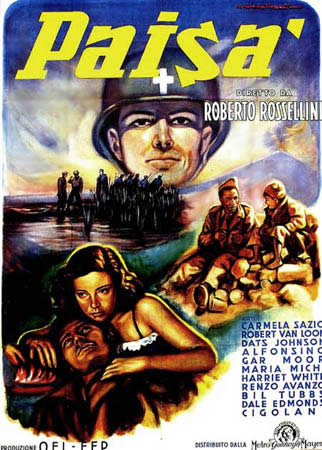
Roberto Rossellini's other classical film on the Resistance is PAISA (1947). Here echoes from the cinema of the past fuse with certain important premises for the development of the cinema of the future. The film is divided into episodes, that is a kind of film rarely exploited in Italy (only two titles come to mind: QUARTA PAGINA [FOURTH PAGE] by Nicola Manzari in 1943 and CIRCO EQUESTRE ZA-BUM [ZA-BUM CIRCUS] by Mario Mattoli in 1944) and ventured with some success only by Hollywood (IF I HAD A MILLION, 1932) and the French (CARNET DU BAL, DERRIERE LA FACADE, PARADE EN SEPT NUITS). Episode films were frequently nothing more than a random collection of short stories. Rossellini, instead, linked each episode to the others: the film as a whole, paints the historical picture of the Allied advance in Italy from the landing in Sicily in June, 1943, to the liberation of the North in 1945. The first and last of the short episodes are starkly tragic, fraught with death. In between, however, the director and his associates alternate humor and drama. See, for example, the two completely comic episodes about Naples (the friendship between a black American soldier and a Neapolitan "sciuscia" of bootblack) and the Romagna (the quandry of a convent of Catholic friars forced to take in two American chaplains of a different religion). Also in PAISA, written mostly, like ROMA, CITTA APERTA [ROME, OPEN CITY], by Sergio Amidei, the humorous touch of Fellini can be detected.

Friday, June 24, 2011

2. The Forties: The Season Of Neo-Realism part two

From: COMEDY ITALIAN STYLE
by Ernesto G. Laura - Compiled by A.N.I.C.A. (National Association of Motion Pictures and Affiliated Industries) Rome, Italy - Edited by CIES Soc. Coop. r.1 (Institute for the Promotion of Italian Motion Pictures Abroad) Rome, Italy under the auspices of the Ministry of Tourism and Entertainment

Even so, as has now been made perfectly clear, Italian cinema cannot historically be divided into two neat division: Fascist-period films on the one side, neo-realism on the other. Many elements of the way films were made before were carried over into the post-war period, even in important works, if for no other reason that the artistic and technical personnel had remained pretty much the same. So it is easy to understand how, in an essentially dramatic and, indeed, tragic genre like neo-realism, the ingredients of comedy were not altogether lacking.

Take ROMA, CITTA APERTA [ROME, OPEN CITY], directed in 1945 by Roberto Rossellini (1906-1977). The great director manages to create a manifold image of a luminous city suddenly plunged into gloom by the Nazi occupation and the deplorable phenomenon of collaborationism. Rossellini shoots on the street, recreating, where it actually took place, a tragedy experienced barely yesterday, the scars of which are still painfully fresh in people's minds. He takes as a point of reference a parish priest, Don Morosini (the story is true), and the mother of a family who sees her man arrested and then tortured to death. Two characters meant to be the exact opposite of the "heros" of the traditional epic cinema and who could never be played by two "cute and glamorous" matinee idols, according to the rules of the star system. So Rossellini chose Aldo Fabrizi and Anna Magnani, the couple of CAMPO DE' FIORI and L'ULTIMA CARROZZELLA [THE LAST CARRIAGE], and carried their usual roles as popular comedy figures up and up, without a hitch, to the heights of tragedy. ROMA, CITTA APERTA [ROME, OPEN CITY] could not have existed without the triptych of comedies which Fabrizi and Magnani had previously appeared in. It was those films that got audiences used to leading actors who were neither glamorous, nor very young, to films shot outside, in the open, with real people, to the use of Roman dialect instead of the polished Italian of the professional actors. To be sure, ROMA, CITTA APERTA [ROME, OPEN CITY] is a masterpiece and the three films that preceded it were, instead, made for sheer entertainment, but the connecting thread between them is clear. Not only, but the presence among the script-writers of the same Federico Fellini of those films made it certain that the material of ROMA, CITTA APERTA [ROME, OPEN CITY] would be "alleviated" from time to time by a few light, but essential humorous touches.