Showing posts with label Ugo Tognazzi. Show all posts

Wednesday, February 1, 2012

13. The "Second Wave" of Comedy Actors part ten

From: COMEDY ITALIAN STYLE
by Ernesto G. Laura
Other actors, some of them international stars, have not been taken into detailed consideration here because their comedy appearances fall into a larger and more complex framework of motion picture activities. Such is the case with Marcello Mastroianni and Monica Vitti. Both have important dramatic interpretations to their credit: suffice it to remember Michelangelo Antonioni's LA NOTTE (NIGHT), in which they appeared together. As to Mastroianni, mention must be made of the Fellini films, from LA DOLCE VITA (THE SWEET LIFE) to LA CITTA DELLA DONNE (CITY OF WOMEN), as to Vitti those of Antonioni, from L'AVVENTURA (THE ADVENTURE) to IL MISTERIO DI OBERWALD (THE MYSTERY OF OBERWALD). Even so, the former's natural inclination to irony, the latter's to caricature, often made it possible to introduce moments of genuine humor into dramatic films.
In the 1950s, Marcello Mastroianni was often one of the young leads in the humorous-sentimental comedies that were in fashion. He then reappears in Ferreri's LA GRANDE ABBUFFATA (THE BIG FEED) and in many more recent comedies (among other things, he starred in the musical comedy, VALENTINO, where in the role of the famous silent film star he danced and sang).
Monica Vitti, instead, appeared more regularly in the film comedy genre. Indeed, several films were made especially to show off her particular whimsical personality. For example, the movie versions of several successful stage works: TI HO SPOSATO PER ALLEGRIA (I MARRIED YOU OUT OF MIRTH: 1967) by Luciano Salce, on the play by Natalia Ginzburg, with Giorgio Albertazzi and Maria Grazia Buccella, L'ANATRA ALL'ARANCIA (DUCK A L'ORANGE: 1975), it too by Salce, from the play by Home and Sauvajon, adapted to the screen by Bernardino Zapponi, with Ugo Tognazzi, John Richardson and Barbara Bouchet, AMORI MIEI (MY DARLINGS: 1978) by Steno, from the play by Jaja Fiastri, with Dorelli and Enrico Maria Salerno, NON TI CONOSCO PIU AMORE (DON'T KNOW YOU ANYMORE, DARLING: 1980) by Corbucci, from an old play by Aldo De Benedetti which had already been made into a film in 1936 at the time of the "white telephone" comedies. The film which revealed most completely the gifts of Monica Vitti, a modern actress who even so identifies herself with the character emotionally, from within, was LA RAGAZZA CON LA PISTOLA (THE GIRL WITH THE PISTOL), directed in 1968 by Mario Monicelli from a story by Sonego adapted to the screen by Sonego and Magni. She is a farm girl from a small Southern town with a very closed mentality, who is "dishonored" by a local boy and goes looking for him in America to kill him and "wash away the disgrace," imagining at every stage of the journey the different ways the execution will take place. Vitti is extraordinary in depicting the various stages in the evolution of the girl, who, as the journey proceeds and she gains new experience, gradually begins to feel less and less disposed to carry out the ritual murder, more a woman, more modern, more mature.

Friday, January 13, 2012

12. Pietro Germi Vs. Moralism part four

From: COMEDY ITALIAN STYLE

by Ernesto G. Laura

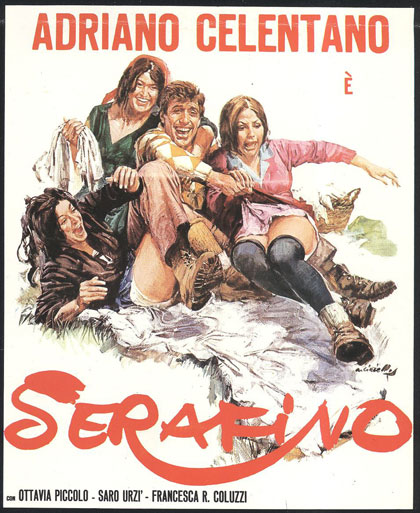
The director returns to a popular world in SERAFINO, which is 1966 won first prize (ex-aequo) at the Moscow Film Festival. On a script written by Giovannetti, Benvenuti, De Bernardi and Pinelli, Germi tells a story about a small Ciociaro town of farmers and shepherds, cut off from the modern world. Most of all it is the portrait of Serafino, a country yokel, lumpish and uncouth but good at heart and very asute, who manages to extricate himself, amidst swindlers and swellheads, and to get along with unruffled serenity, veritable symbol of the pure, unspoiled popular soul. By no accident, of the people around him the only figure who is to a certain extent lovable and positive is Asmara, a young village prostitute, the mother of countless children (excellently portrayed by Francesca Romana Coluzzi). Of particular interest the dialogue, where for the first time slighting "bawdy" verbal expressions are used, typical of the way a peasant would speak. The film launched the acting career of a pop singer, Adriano Celetano, who will be further discussed in the last chapter, revealing in him outstanding qualities as a spontaneous and appealing actor.

At the time of his death, Germi was preparing AMICI MIEI (MY FRIENDS: 1975), which was then directed by Mario Monicelli with the utmost respect for the intentions and desires of the late director, so that while Monicelli appeared in the credit titles as the director, a notice was added with the words: "a film by Pietro Germi".

After Sicily, the Veneto and Lazio, now it was Tuscany which, from the time of Giovanni Boccaccio's classic novelle, has been the land of the practical joke, the sarcastic jibe, the sometimes even cruel prank. Five fifty-year old friends, distinguished professionals in life, are used to getting together from time to time to play sensational jokes in the most unimaginable places, often devised, planned, and carried out on a large scale. Life, however, cannot be brought to a halt byt his childish way of staying twenty when you are more than twice the age, and the death of one of them would end by giving them a glimpse of the bitter fact that the days of games and horseplay are over. Whimsical, bizarre, jocose, interrupted by frequent thrusts of grief and drama, AMICI MIEI (MY FRIENDS) blends the finest qualities of Germi and Monicelli in a satirical representation of penetrating depth. The five friends are Tognazzi, Philippe Noiret, Gastone Moschin, Adolfo Celi and Duilio Del Prete, while Bernard Blier plays the part of Righi, their chosen victim.

Thursday, January 12, 2012

12. Pietro Germi Vs. Moralism part three

From: COMEDY ITALIAN STYLE

by Ernesto G. Laura

In 1966, Germi won the Gold Palm (ex-aequo) at the Cannes festival with SIGNORE E SIGNORI (LADIES AND GENTLEMEN), in which he moves his criticism of manners to the Veneto bourgeoisie, using the town of Treviso as his geographical and social setting. Veneto writer Luciano Vincenzoni collaborated closely with the director on the story and script (Age and Scarpelli helped with the latter), fitting together a mosaic teeming with figures, large and small, of a colorful human "bestiary", caught in the merry-go-round of hypocrisy which Germi attacks with a firm polemical thrust. A multitude of well-known actors moves through the film, each given a space of his own: from Alberto Lionello to Olga Villi, from Gigi Ballista and Gaston Moschin to Virna Lisi and Franco Fabrizi.

One gets, even so, the impression that Germi didn't preserve on screen everything he had observed and that the film, however amusing and well-constructed and however skillful the dialogue, offers a less definitive picture of that bourgeois society than it could have been, sometimes bordering on the caricature sketch, which is something less than satire.

L'IMMORALE (THE IMMORALIST: 1967) was polemical, starting from the title itself. Instead of the analysis of a provincial society, as in his other two comedies, the director (with the collaboration on the script of Alfredo Giannetti, Tullio Pinelli and Carlo Bernari) pauses to shed light on the paradoxical situation of a single character, a violinist who, with a certain seriousness of his own, takes up with other women aside from his wife, ends up having three homes and three families, children included, and is forced to run from one train to another to keep his different wives happy and also wearing himself out from the fulfillment of his marriage "duties", until he dies from a heart attack. Germi doesn't pass judgment but is interested in exploring the soul of this man, who from the outside would seem to be a kind of playboy but is capable, instead, of a very special and sincere kind of loving of his own. Ugo Tognazzi was the violinist, Stefania Sandrelli, Renee Longarini and Maria Grazia Carmassi his three women.

Thursday, January 5, 2012

11. Comedy Dresses Up part four

From: COMEDY ITALIAN STYLE

by Ernesto G. Laura

FAUSTINA (1969), Luigi Magni's first film as a director, is to be sure given a modern setting but ancient Rome plays an important part. The main characters, in fact, are "tombaroli", that is those people who steal from Roman and Etruscan tombs, who are specialized in archeological plunder and then sell the precious finds to foreign collectors. The sudden appearance in that milieu of a young dreamer would captivate Faustina, the "tombarolo's" black wife, leading to a series of consequences to be explained mostly by that strange profession and the background of ruins where the characters live. Enzo Cerusico, an Italian better known in America than in Italy as a result of a number of television serials and appearances on Broadway, was the poetic inamorato, Vonetta McGee the young bride, Renzo Montagnani the coarse robber.

The satirical force of G.G. Belli's sonnets in Roman dialect seems to inform Magni's next film, NELL' ANNO DEL SIGNORE (IN THE YEAR OF OUR LORD...: 1969), it too appearing in the wake of RUGANTINO. The period and place are the same: Rome around 1825, identical the actor set against that historical background, Nino Manfredi, who is Cornacchia, a cobbler who pretends to be illiterate but is actually Pasquino, known all over Rome for his anti-papal invectives. The imaginary events are interwoven with a true historical episode, the execution of the conspirators of the Carboneria (a secret society from the time of the Risorgimento), Montanari and Targhini, which took place, as a plaque indicates even today, in Piazza del Popolo. Also appearing in the film were Ugo Tognazzi, in the role of the treacherous and shifty Cardinal Rivarola, and Alberto Sordi in that of a fanatical monk.

In 1970, Magni wrote and directed, less successfully but always on a high level of entertainment, SCIPIONE DETTO ANCHE L'AFRICANO (SCIPIO KNOWN ALSO AS THE AFRICAN), where the action was carried back to Imperial Rome in order to satirize the political intrigues of power at the time the Roman General was preparing to defeat Carthage. Along with Marcello Mastroianni in the title role, Magni used his brother, Ruggero Mastroianni, a well-known Italian film editor, Vittorio Gassman, Turi Ferro and Silvana Mangano.

Wednesday, December 21, 2011

10. Vittorio Gassman From Great Tragedian To Subtle Comedian part four

From: COMEDY ITALIAN STYLE

by Ernesto G. Laura

The Gassman-Tognazzi team worked much better than the Gassman-Sordi team: both were actors, for example, with a fondness for disguises, impersonations, for "re-inventing" themselves from top to toe, and the arrogance, presumptiousness and impetuosity of Gassman's character type contrasted nicely with the falsely submissive slyboots played by Tognazzi. In I MOSTRI (THE MONSTERS: 1963) Risi brought them face to face in a memorable contest of acting skill which reached moments of sublime hilarity in the episode, La nobile arte (The Noble Art), where they play two punch-drunk boxers, one reduced to poverty, the other a small-time waiter, both yearning for the victory that would bring them fame and riches. Many years later, in 1977, a sequel was made, I NUOVI MOSTRI (THE NEW MONSTERS), directed by Risi, together with Monicelli and Scola.

In 1971, Risi brought the two actors together again in non-farcical, much more restrained character parts in the film IN NOME DEL POPOLO ITALIANO (IN THE NAME OF THE ITALIAN PEOPLE), written by Age and Scarpelli, where Tognazzi is a magistrate of the utmost integrity who prosecutes a dishonest and arrogant industrialist (Gassman) for a crime he strongly suspects he has committed. But when he had proof that the man is innocent, he destroys it in order to punish in him, above and beyond the innocence of his specific case, the symbol of the corruption and ills of society.

The best film Risi directed with Gassman is IL SORPASSO (THE OVER-TAKE, aka THE EASY LIFE: 1962), a caustic psychological comedy based on the moral duel between the arrogant Bruno (Vittorio Gassman) and the mild-mannered student Robert (Jean-Louis Trintignant), ending, after a wild car race that becomes the symbol of a way of life, with the tragic death of the boy. The comedy is not afraid of ignoring the "happy end" and of leaving the spectator with the disconcertion of an abruptly tragic conclusion. Bruno, at the sight of the young man's body thrown out of his car, has for the first time a look of amazement and dismay on his face and perhaps begins to realize he has lived up till then in the most absolute moral void.

Monday, December 19, 2011

10. Vittorio Gassman From Great Tragedian To Subtle Comedian part three

From: COMEDY ITALIAN STYLE

by Ernesto G. Laura

With I SOLITI IGNOTI (UNKNOWN, AS USUAL), a new Italian film star was born and the star was a comedian: Vittorio Gassman. The following year confirmed it with LA GRANDE GUERRA (THE GREAT WAR), again by Monicelli, which has already been discussed with regard to Sordi, who was teamed up with Gassman. In IL MATTATORE (THE MUMMER: 1960) by Dino Risi, the actor finally had a vehicle devised and tailored especially for him, where, through the story of an international swindler who presents himself in different disguises, he could show off all his virtuoso skill in constantly changing make-up and character. Risi is the director most responsible for consolidating Gassman's role within the framework of Italian-style comedy. In LA MARCIA SU ROMA (THE MARCH ON ROME: 1962), he replaces the team of opposites, Gassman-Sordi, invented by Monicelli, with the team of Gassman and Ugo Tognazzi.

The march on Rome was a parody of revolution, that is the march on the Capital by four different columns of Fascists in 1922, poorly equipped and under-armed, which would have taken only a few soldiers to stop. But the King, as is know, didn't have the courage to give orders to fire and yielded, immediately after giving the task of forming the government to Mussolini, who hadn't taken part in the march and cautiously staying in Milan, ready to flee to Switzerland if things turned out for the worse; and when the King summoned him to Rome, he demanded a written invitation so as to avoid any nasty surprises, then rode down in a sleeping-car like any normal citizen. To base a film on the "march" of one of these columns from the North to the Capital was a good idea. Ghigo De Chiara, Continenza, Age, Scarpelli, Scola and Maccari wrote the script. The parts played by Gassman and Tognazzi resemble the ones that had given them success: the former is a cocky, blustering Fascist, basically naive deep down inside, like the Giovanni Busacca in LA GRANDE GUERRA (THE GREAT WAR); the latter a slightly dim-witted farmboy, convinced by Fascism but prepared to take stock of reality, like IL FEDERALE (THE FEDERALIST) in Salce's film.

Friday, December 9, 2011

9. Ugo Tognazzi: From the Farce To the Comedy of Manners part seven

From: COMEDY ITALIAN STYLE

by Ernesto G. Laura

Gian Luigi Polidoro is, among the directors of comedy, one of the ones who has sought to innovate within the tradition. An example of this is PERMETTETE, SIGNORA, CHE AMI VOSTRA FIGLIA? (YOU MIND, MADAM, MY LOVING YOUR DAUGHTER?: 1974), based on a script written by Rafael Azcona, Leo Benvenuti and Pietro De Bernardi, in which Tognazzi, in a highly complex performance, wholly constructed from within, depicts a "ham" actor who, by dint of acting in a play about Mussolini for small-town audiences, identifies himself with the memory of the late dictator and when, as a joke, they put him to the wall he thinks he is really about to be executed like the "Duce". The film is uneven, with moments of banality alternating with flashes of great satire, but the reconstruction on the poor company's stage of certain moments in the life of Mussolini constitute a pungent and convincing piece of cinema.

With ROMANZO POPOLARE (POPULAR NOVEL: 1974), Mario Monicelli, supported by a script written by him with Age and Scarpelli, also seek new paths for Italian-style comedy. As the title indicates, he attempts to transfer a mechanism till then typical of bourgeois comedy (him, her, the other man, suspicions of adultery, separations, quarrels and reconciliations) into a popular setting. So Tognazzi is a Milanese worker of middle age, married to a girl who then betrays him with another young worker. Faced with the facts, old as the world, the man's "liberal" and "open" views melt away like snow in summer and he kicks the adultress out of the house. Tognazzi, Ornella Muti, Michele Placido play their parts, expressing themselves in a language realistically based on the normal speech to be found among the Milanese working classes, with detached amusement, engaged in a playful game not lacking in bitterness.

Dino Risi takes Tognazzi back to the characters of Pietro Chiara in LA STANZA DEL VESCOVO (THE BISHOP'S ROOM), a novel that the writer himself adapted to the screen together with Benvenuti and De Barnardi. The film is set on Lago Maggiore, with a handsome villa overlooking the lake and peaceful boat rides, and is centered around the figure of Orimbelli (Ugo Tognazzi), falsely cocky in his rich man's vulgarity and virile exhibitionism who in the end kills himself instead. In PRIMO AMORE (FIRST LOVE: 1979), Risi deals with the familiar subject of an older man's passion for a young girl, but endowing it with richer meanings, seeing as how Tognazzi is an old retired vaudeville comedian and the girl a maid in the rest home where he lives. The elopment of the lovers to Rome collides brutally with reality: the girl, going from one bed to the other, makes a career for herself on television, he without a cent to his name, a professional failure, goes back to the rest home, resigned to being old. Despite a few vague similarities to Neil Simon's THE SUNSHINE BOYS, the film leads the comedy genre, with its humorous contents, to reflect upon, in an original fashion, the transition from middle age to old age, from active life to retirement.

Ugo Tognazzi, like Sordi and Manfredi, directed a film from time to time, though they weren't his best films. After IL MANTENUTO (THE GIGOLO: 1961), still primitive, he attained better results in IL FISCHIO AL NASO (FEELING FUNNY) in 1967, based on one of the most successful short stories of Dino Buzzati, SETTE PIANI (SEVEN FLOORS), adapted to the screen by the actor-director himself with the collaboration of the writers he used at the time for his theater and television work, the Florentines Giulio Scarnicci and Renzo Tarabusi, as well as Alfredo Pigna. Buzzati tells the harrowing story of a man who is admitted to a clinic for a silly ailment that doesn't worry him in the least. In the clinic, the patients are divided by floor, from the highest to the ground floor, according to the seriousness of their condition. So he is obviously assigned to one of the upper floors, except, under various pretexts, he is moved lower every day and realizes he is condemned to death. Tognazzi replaces the atmosphere of metaphysical anguish of the original story with motivations of a lighter and more easily understandable sort, and that is a very concrete affair of interests between relatives and the managers of the clinic, and the accent shifts, without explanation, from a pure and simple thriller to the grotesque. Even so, the film works, thanks to a finely-wrought performance and a driving pace. Tognazzi took a story by Tonino Guerra, Franco Indovina and Luigi Malerba for his third film, SISSIGNORE (YES SIR: 1968), the ludicrous portrait of a chauffeur who spends his life covering up the misdeeds, the swindles and love-affairs of his boss, in the end being sentenced to prison for life. While his fourth film, CATTIVI PENSIERI (EVIL THOUGHTS: 1976), seems less important, I VIAGGIATORI DELLA SERA (THE NIGHT TRAVELERS), a science-fiction fable, based on a novel by Umberto Simonetta, about a future society in which old people kill themselves, is of a certain distinction, despite some rather slow moments.

Thursday, December 8, 2011

9. Ugo Tognazzi: From the Farce To the Comedy of Manners part six

From: COMEDY ITALIAN STYLE

by Ernesto G. Laura

Perhaps the comedy the least "Italian-style" (by no accident, it was made in Paris) is LA GRANDE ABBUFFATA (THE BIG FEED: 1973) by Marco Ferreri, where the black humor dear to the director attains the maximum effect: to joke about a collective suicide organized by four food-loving friends in a secluded villa, each one dying from the excesses of one last gigantic banquet. The film was the result of a close collaboration between the actors - Marcello Mastroianni, Ugo Tognazzi, Michel Piccoli, Philippe Noiret - and Ferrari, improvising dialogue and action and acapting everything to the true psychological personality of the respective actors, who by no accident kept their own names. Extravagant and terrible, gruesome and scintillating, it is certainly the finest "grotesque" made by an Italian director. Ferrari was also responsible for another striking caricatural performance by Tognazzi in NON TOCCARE LA DONNA BIANCA (DON'T TOUCH THE WHITE WOMAN), a sort of exacerbated, sophomoric but often irresistible parody of film Westerns and in particular those based on the defeat of General Custer, shot in Paris in 1974 in the "hole" left in the center of town by the destruction of Les Halles, the old general markets. The natural pit, in the context of a modern-day Paris with its normal, swirling traffic, becomes the bizarre set of this historical reconstruction played for laughs, with Tognazzi in the role of a teacherous redskin, Mastroianni of a blood-thirsty, puritanical and health-nutty Custer, Michel Piccoli of a homosexual Buffalo Bill.

In LA PROPRIETA NON E PIU UN FURTO (OWNING PROPERTY IS NO LONGER A THEFT: 1973), by Elio Petri and written by Petri and Ugo Pirro, the search for a wholly symbolic, allegorical form of comedy is what makes the film undoubtedly interesting. It revealed a new actor, the skinny, wild-eyed Flavio Bucci, in the role of a neurotic bank clerk who comes to the conclusion that in a society based on legalized theft and exploitation, the only serious form of dissent is to start stealing. He takes as the symbol of the society he hates a rich butcher, Ugo Tognazzi, and starts persecuting him, first by stealing his hat, then a special knife, lastly his girl friend and then planning to clean out his apartment. Too bad the story was not served by a coherent style and frequently remained at the stage of good intentions, merely stated rather than artistically resolved, but Tognazzi's butcher and Bucci's thief were first-rate.

Wednesday, December 7, 2011

9. Ugo Tognazzi: From the Farce To the Comedy of Manners part five

From: COMEDY ITALIAN STYLE

by Ernesto G. Laura

While, as has been observed,the interchange between film comedy and stage comedy was rare in Italy, that between films and literature was instead quite intense. One of the directors most skilled in translating the written word into visual imagery, Alberto Lattuada, was the first to bring to the screen the particular world of the writer Pietro Chiara, adapting his novel, LA SPARTIZIONE, in the film VENGA A PRENDERE IL CAFFE...DA NOI (COME HAVE A CUP OF COFFEE...AT OUR HOUSE: 1970), on a script written by Chiara, Tullio Kezich and Adriano Baracco. Chiara is a Lombardy writer, stinging in his attacks on certain backstairs carryings-on among the apparently irreprehensible bougeoisie of his district. Emerenziano is a middle-aged Internal Revenue officer who moves to a small town on the Lake of Como and there marries an old maid recently come into money, settling down in the house where she and her two sisters live, with all of whom (including the maid) he establishes a discreet and perfect sexual menage, to the delight and satisfaction of one and all.

The case of well-known writers who take up film directing is also not uncommon. Alberto Bevilacqua came out in 1970 with LA CALIFFA (THE CALIPHESS), based on his novel, where Tognazzi, in a story with a tragic ending, vigorously and intensely portrays the figure of an industrialist who has an affair with a working girl who until then has heartily opposed him as her "boss". In the affair, both of them are forced to pay a price: he, persuaded, by frequenting the girl, to have a clearer understanding of the arguments of his dependents, is unpopular and accused of being "progressive" by his business colleagues, and she is viewed suspiciously by her fellow workers who fear she has gone over to the boss' side. Subtler and more disturbing, the second psychological comedy, it too with specific social references, filmed by Alberto Bevilacqua: QUESTA SPECIE D'AMORE (THIS SORT OF LOVE: 1972). Tognazzi plays the double role of Federico, a forty-year old man of lowly origins who lives in Rome at his rich wife's expense, and of Federico's father, who has stayed behind in Parma and lives among the simple people. Whent he marriage starts to break up, destroyed by emptiness and boredom, Federico goes back to Parma to visit his father and rediscover the real roots of his own world and hence of his own life. His wife, who joins him, also discovers she has changed and their marriage seems to find new strength because their love has not completely died. But once back in Rome, they pick up the old routine and their separation is inevitable.

Tuesday, December 6, 2011

9. Ugo Tognazzi: From the Farce To the Comedy of Manners part four

From: COMEDY ITALIAN STYLE

by Ernesto G. Laura

Sometimes, but rarely, the Italian-style comedy turned to the theater as a source of inspiration (it is even so the exception andnot the rule as is instead the case with the frequent passing of stage hits from Broadway to Hollywood). Such was the case with LIOLA which Alessandro Blasetti directed in 1964 on the Luigi Pirandello play in which Tognazzi skillfully portrays the leading character, an incorrigible woman-chaser in a Sicilian village, surrounded by a swarm of children. It was also the case with IL MAGNIFICO CORNUTO (THE MAGNIFICENT CUCKOLD: 1964) by Antonio Pietrangeli, based on the charming play by Fernand Commelynck, where the Parisian "vaudeville" is taken as a model for an ironical speculation on the meaning of jealousy, revealing, under the equivocations, an almost Pirandellian search for the "truth" and non-superficial human meanings. A certain Pirandellian flavor, though based on an original story (by Enzo Gicca Palli), also marks UNA QUESTIONE D'ONORE (A QUESTION OF HONOR) with which Luigi Zampa in 1966 aimed his satirical darts at the codes of honor typical of certain ancient and rigid mores in Sardinia. The conflict between the forms to be respected and the truth which cannot be revealed is the main problem of the protagonist, Efisio Mulas (Tognazzi), convinced by relatives and friends to kill his wife for supposed adultery which he cannot deny without implicating himself in a murder, so he is forced to kill his innocent spouse.

A return to the subject of the middle-aged man who loses his head over a young girl is successfully handled in LA BAMBOLONA (THE BIG DOLLL: 1968) by Franco Giraldi, on the novel of the same title by Alba de Cespedes. Giraldi also directed Tognazzi in CUORI SOLITARI (LONELY HEARTS: 1970) which is a scathing satire of "couple swapping" in the framework of an indolent and bored provincial society looking for amusement.

Thursday, December 1, 2011

9. Ugo Tognazzi: From the Farce To the Comedy of Manners part three

From: COMEDY ITALIAN STYLE

by Ernesto G. Laura

The director who contributed the most to turning Tognazzi into an important actor, also internationally, was not Salce however, but Marco Ferreri. UNA STORIA MODERNA: L'APE REGINA (A MODERN STORY: THE QUEEN BEE), which won the award for the best actress, Marina Vlady, at the 1963 Cannes Festival, was based on an idea by Goffredo Parise and turned into a film script by Rafael Azcona and Ferreri with the collaboration of Diego Fabbri and the Massimo Franciosa-Pasquale Festa Campanile team. The misogyny of Ferreri (and of Parise) takes the form of a symbolic fable about the failure of a marriage which everyone thinks is going perfectly. Tognazzi is a wealthy, forty-year old bachelor who decides to get married and with the help of a priest finds a girl, Regina, who seems ideal: beautiful, wholesome, young, from a good family, serious, religious. After becoming his wife, Regina wants to have a child, but Alfonso doesn't succeed in giving her one. Convinced that a marriage without offspring is worthless, she nails him down to his obligations and forces him to "perform" more and more frequently and intensely. He yields, wearing himself out physically and psychologically, and she, true queen bee, drains the male of all vitality until she succeeds in getting pregnant; but at that point the husband dies. A ferocious satire of manners, in keeping with the iconoclastic and sacrilegious inclinations of Azcona and Ferreri, it reveals in Tognazzi an actor of great restraint and gentle soul opposite a Marina Vlady rightly harsh and aggressive, firm in her determination.

In 1964, Marco Ferreri directed him in LA DONNA SCIMMIA (THE MONKEY WOMAN), teamed up with another French actress, Annie Girardot. In a certain sense, it's the reverse of Fellini's LA STRADA (THE ROAD): the romance between a normal man and a hairy-faced woman who looks like a monkey. The man takes her out of the institution where she is an inmate, exhibits her as a "living phenomenon" in fairs and carnivals and marries her. The ambiguity of the situation lies in the fact that the man loves her and at the same time exploits her, and when she dies in childbirth he has the bodies of she and the child stuffed and goes on exhibiting them in his booth. Ferreri finds in Tognazzi and Girardot two ideal actors because they don't "overload" the situation, but deal with it as if it were perfectly normal, lending even greater relief to the director's paradoxical humor.

Wednesday, November 30, 2011

9. Ugo Tognazzi: From the Farce To the Comedy of Manners part two

From: COMEDY ITALIAN STYLE

by Ernesto G. Laura

He could have gone on like that for who knows how long without the film that established him as a complete actor: IL FEDERALE (THE FEDERALIST), directed by Luciano Salce in 1961 and written by him with Castellano and Pipolo. In 1944, in Nazi-occupied Rome, Primo Arcovazzi is a modest non-com in the Black Brigades, a Fascist ingenuosly confident of the "certain victory," zealous and unquestionably a little stupid, who is given the assignment of going to the Abruzzi and arresting and bringing to Rome a distinguished anti-Fascist university professor whom the democrats plan upon making the President of The Republic, once Italy is liberated. Arcovazzi rides off in a motorcycle with sidecar, no automobile being available in those difficult times, and amidst endless vicissitudes returns with the prisoner. Except that the Allies have meanwhile reached Rome and Arcovazzi, who is traveling in a Mussolini black shirt, risks ending up in front of a firing squad; it is the professor who saves his life. The "gimmick" of the comedy is in bringing face to face two opposite mentalities, that of the dim-witted Fascist, who believes in all the slogans of the regime, and that of a liberal intellectual, wise and tolerant, who without ever pinning him to the wall, leads him little by little to understand certain things, to open his mind to a more responsible and critical evaluation of what is going on. In other words, a dialogue on the values of democracy and freedom, carried on in the midst of a hundred incidents and the risk of an active war. Though his partner was an illustrious name in the French cinema and theater like Georges Wilson, Tognazzi succeeded in emerging, drawing an exhilirating but penetrating portrait of his dull-headed Fascist.

In 1962, Luciano Salce would again lead him into the terrain of comedy with LA VOGLIA MATTA (THE MAD DESIRE), based on a short story by Enrico La Stella. Tognazzi's Berlinghieri is a character that would also be found in other films, the middle-aged man who falls madly in love with a much younger girl. Scintillating and gay, the film contains sudden turns of bitterness: Berlinghieri and Francesca do not succeed in overcoming the difference in age and their affair comes to an abrupt end. Tognazzi's third important collaboration with Salce (and the script-writers Castellano and Pipolo) was in 1963 with LE ORE DELL'AMORE (THE HOURS OF LOVE), a pungent, ironical, analysis, with some dramatic moments, of the crisis of a couple after marriage has legalized a long affair: they will go back to loving each other only when they are no longer husband and wife (the same theme, viewed from a completely different angle, of Ingmar Bergman's SCENES OF A WEDDING).

Tuesday, November 29, 2011

9. Ugo Tognazzi: From the Farce To the Comedy of Manners part one

From: COMEDY ITALIAN STYLE

by Ernesto G. Laura

More and less the same age as Sordi (1920) and Manfredi (1921), Ugo Tognazzi, born in Lombardy in 1922, is the third popular name around which the Italian-style comedy developed over the last twenty years. Unlike the others, however, he didn't serve his apprenticeship in the movies: in 1950, when he appeared in his first film (I CADETTI DI GUASCOGNA - THE CADETS OF GASCONY - directed by Mario Mattoli) it was already in a starring role. And yet it took some ten years of successful but mediocre films for him to escape the routine of superficial farces and be given more substantial roles in comedies of manners.

Like Sordi, Tognazzi had worked hard for many years in variety shows, rising from the small-time vaudeville theaters on the outskirts of town to the big musical revues. In 1950, he was still not a popular star like Macario, for whom he was a stand-in, or Toto, even so his revues were among the most modern in their texts (written first by Gelich and then by Scarnicci adn Tarabusi) and in their "formula": he was the first to introduce, instead of the traditional humor, the "nonsense comedy" that became known in Italy especially after the success of Potter's HELLZAPOPPIN; he was the first to mix together big spectacular numbers with more intimate and restrained cabaret acts.

When Italian motion pictures found it convenient to make series of films for every successful variety show comedian, Tognazzi also got his space on the screen; it was at that time, however, that Toto reigned supreme in films of that kind. In 1954, the newly born Italian television gave him the possibility of enormously enlarging his circle of fans with a Saturday night show, UN DUE TRE (ONE TWO THREE), that for several years was at the top of the popularity polls. Working with Raimondo Vianello, his "stooge" but not exactly a partner in the theater, he formed an extraordinary comedy team. Next to Vianelli, tall and thin with washed-out hair, physically and psychologically immersed in a British kind of humor played absolutely deadpan, Tognazzi stood out both because of his extraverted dash and the cunningness of a certain crafty guile.

In the days of the great popularity of stage revues, Tognazzi was primarily an eminent representative of that genre of entertainment and secondly a familiar television face; the movies were a sideline, nothing particularly important, in which he alternated leading roles in second-rate films and brief appearances as "guest star" in some even important films. The latter was the case with CHE GIOIA VIVERE! (WHAT A JOY TO BE ALIVE!), directed in Italy in 1961 by French director Rene Clement and starring another Frenchman, Alain Delon, an affectionate and light-hearted portrayal of 1921 Rome through an endearing family of anarchists. Tognazzi for the first time called attention to himself in a secondary but amusingly sketched role: a Bulgarian terrorist who has come to Rome to carry out an assassination.

Wednesday, November 16, 2011

8. Nino Manfredi Outside the Set Character part five

From: COMEDY ITALIAN STYLE

by Ernesto G. Laura

That Manfredi refused to limit herself to a set character does not mean, however, that he denied those Ciociaria peasant roots which go to make up an important part of his personality. His Marino Balestrini, a village barber, in STRAZIAMI, MA DI BACI SAZIAMI (TORTURE ME, BUT FILL ME WITH KISSES: 1968) by Dino Risi, extracts from precisely this social and geographical background its perfect description as a character. The story, written by Age and Scarpelli, more than once touches upon death creating out of it occasions for laughter: when the young engaged couple tries to commit suicide for love, when Marino, out of a job, jumps into the Tiber, lastly when he and his former girlfriend try to bump off her deaf-mute husband. A paradoxical plot leads to a complex story, now caricatural now pathetic, where the American actress, Pamela Tiffin, is the pretty village girl fought over by the barber, Nino Manfredi, and her husband, Ugo Tognazzi. RIUSCIRANNO, I NOSTRI EROI A RITROVARE IL LORO AMICO MISTERIOSAMENTE SCOMPARSO IN AFRICA? (WILL OUR HEROES SUCCEED IN FINDING THEIR FRIEND WHO HAS MYSTERIOUSLY DISAPPEARED IN AFRICA?) is the mile-long title of a bizarre film Ettore Scola made in 1968 on a script by Age, Scarpelli and the director. The remote inspiration of the film is Stanley's trip to find Livingstone, but bought up to date and adapted to modern times. It would be a Roman publisher, Alberto Sordi, accompanied by one of his employees, Bernard Blier, in the capacity of collaborator, driver and in other words, slave, to go to Africa to follow the traces, at first feeble then more and more substantial, of his brother-in-law, Nino Manfredi, who had disappeared months before. They would find him in a native village, acting as witch doctor to the tribe and not the least bit anxious to go home: in that particular status he makes his protest against industrial civilization. Age and Scarpelli were also the authors of ROSOLINO PATERNO, SOLDATO... (ROSOLINO PATERNO, SOLDIER...), directed in 1970 by Nanni Loy and meant as a vehicle to launch Manfredi on the American market. But after TUTTI A CASA (EVERYBODY HOME), it was difficult to say something new about the war in Italy in 1943, and the comedy with pretences of historical popularization did not turn out as incisive as it could have been. It tells of the vicissitudes of an Allied commando unit parachuted into Sicily at the beginning of 1943 to prepare for the Anglo-American landing. One member of it is an Italian prisoner-of-war, the soldier of the title, who is supposed to act as guide but who is interested only in escaping to go see his home-town girl-friend. Manfredi co-starred with three American actors: Peter Falk, Jason Robards, Jr. and Martin Landau (who later became popular on television in the Space 1999 series).

Friday, October 7, 2011

5. The Episode Films part fifteen

From: COMEDY ITALIAN STYLE

by Ernesto G. Laura - Compiled by A.N.I.C.A. (National Association of Motion Picturese and Affiliated Industries) Rome, Italy, edited by CIES So. Coop. r. 1. (Institute for the Promotion of Italian Motion Pictures Abroad) Rome, Italy, under the auspices of the Ministry of Tourism and Entertainment

As a curiosity, mention may be made in this period of I TRE VOLTI (THE THREE FACES), organized in 1965 by the producer Dino De Laurentiis to launch - in vain - the former Empress of Iran, Soraya, as a film star. The opening "number," entitled Prefazione (Preface), half-way between the alleged objective of a would-be documentary and the ironical desecration of a tabloid myth, in which Michelangelo Antonioni reconstructed the secret screen test given by De Laurentiis to the Shah's repudiated wife. The most amusing story, however, was the last, Latin Lover, directed by a young director, who died before his time, Franco Indovina (1932-1972), with elegant and restrained humor. Alberto Sordi, co-author of the script, with the faithful Sonego, dominated the screen however, reducing Soraya to the purely decorative role of "foil".

In many other films where the link between the episodes is accidental, often determined by the demands of distribution (more big box-office stars) or footage (enough episodes to fill the standard hundred minutes), only the really important episode need be mentioned. In I COMPLESSI (THE COMPLEXES: 1966), Luigi Filippo D'Amico (script by Sonego) tells the amusing story of a man with enormous buckteeth who wins a contest for television announcers only because no one, in the face of his brazen self-assurance, has the courage to tell him he is not suited to television. In LE FATE (THE FAIRIES: 1966), Antonio Pietrangeli (another story by Sonego) describes in Fata Marta (Martha The Fay) a situation similar to that of Chaplin's CITY LIGHTS: this time it's a rich lady who makes love to her butler only when she is under the effects of alcohol. In I NOSTRI MARITI (OUR HUSBANDS: 1966), the episode Il marito di Attilia (Attilia's Husband) by Dino Risi (written by Age, Scarpelli and Stefano Strucchi) tells the story of the uncomfortable situation of a carabineer (Tognazzi) finds himself in on a secret mission to the suburban underworld, disguised as a streetcleaner and forced to deal with a local crook's fierce jealousy of his wife. In LE COPPIE (THE COUPLES: 1968), it is the third episode, La camera (The Room), that stands out for its acuteness and brilliance of representations; directed and interpreted by Sordi, it tells the story of an ordinary man of modest means who decides to experience at least once a rich man's holiday and goes to a luxurious hotel on the Costa Smeralda in Sardinia , where he is icily disregarded as not being "up to" either the clientele or the personnel. In LA CONTESTAZIONE GENERALE (THE GENERAL DISSENT: 1970) by Luigi Zampa, the episode Concerto a tre pifferi (Three-Fife Concerto), made in the still-heated atmosphere of student dissent which started on the Berkeley campus in the United States, then exploded in Paris in May, 1968, and from there spread to Italy), effectively portrays the awkward attempt of a respectful office worker to contradict for once the industrial tycoon whose "errand-boy" he is, all this in order not to make a bad impression on his dissenter son. The contrast between the subtly nuanced performance of Nino Manfredi and the wonderful olf-fashioned show-stealing of French actor Michel Simon is a joy to watch.

In any case, at the beginning of the '70s, episode films went out of fashion, though some were produced from time to time. But it was precisely then that one of the most unique Italian directors (and poet, novelist, literary critic), Pier Paolo Pasolini, set the seal on the genre with three successive films in which comedy and in particular episode comedy was carried to a high level of artistic quality: IL DECAMERON (THE DECAMERON: 1971), I RACCONTI DI CANTEBURY (THE CANTERBURY TALES: 1972) and IL FIORE DELLE MILLE E UNA NOTTE (ARABIAN NIGHTS: 1974), the first derived from the book by Giovanni Boccaccio, the second from Chaucer and the third from the collection of Arabian folk tales by the same name. The best is probably IL DECAMERON, where some of the short stories by Boccaccio, literary gems of 14th century Italy, are moved from Florence to Naples and recreated in an atmosphere of exuberant vitality, set into motion by a taste for even cruel derision and incessant eroticism, and in a popular key effectively applied to the world of the Middle Ages.

Episode comedy reaches its highest moment in the literary trilogy of Pasolini. Spectacle and entertainment, neither of which are lacking, provide constant glimpses of human reality, the smile, or rather the open, often "wicked" laughter of the popular jest, conceal behind the mask of merriment sudden and unexpected dramatic turns.

Tuesday, October 4, 2011

5. The Episode Films part thirteen

From: COMEDY ITALIAN STYLE

by Ernesto G. Laura - Compiled by A.N.I.C.A. (National Association of Motion Pictures and Affiliated Industries) Rome, Italy - Edited by CIES Soc. Coop. r. 1 (Institute for the Promotion of Italian Motion Pictures Abroad) Rome, Italy under the auspices of the Ministery of Tourism and Entertainment

Among the directors reluctant to let themselves be enclosed into facile categories, Marco Ferreri showed he had grasped the dimensions of the short story in the excellent episode , Il professore (The Professor), in CONTROSESSO (COUNTERSEX: 1964), in which, with the help of a script by the Spanish humorist Rafael Azcona, Ugo Tognazzi draws, in the pithy tones of a psychological satire, the figure of a teacher, to outward appearances a moralist but actually afflicted by sexual deviations. Azcona is a specialist of "black humor" and is at his best in the script of L'UOMO DEI CINQUE PALLONI (THE MAN OF THE FIVE BALLOONS), directed by Ferreri as a feature film, then reduced to the dimensions of an episode in OGGI, DOMANI E DOPODOMANI (TODAY, TOMORROW AND THE DAY AFTER: 1965) and later re-edited and distributed in its original form. An industrialist (Marcello Mastroianni) comes home with some rubber balloons to blow up and gradually becomes obsessed by them ("how long do you have to blow before they burst?"), until he jumps out the window. The customary team of Ferreri, director, and Azcona, script-writer, comes up with a full-length episode film in 1966 MARCIA NUNZIALE (WEDDING MARCH). It consists of four stories about marriage, suspended between the present and the future. In Prime nozze (First Wedding), Tognazzi organizes an authentic wedding, down to the smallest details, between his bitch, Camilla, and the dachshund Luther; in Il dovere coniugale (Marriage Duty), the actor is an ordinary little man oppressed by an over-delicate and demanding wife, a meddlesome mother-in-law and a spoiled child; in Igiene coniugale (Marriage Hygene), Tognazzi and Alexandra Stewart are the symbols of an average American couple of New York in a certain satirical vision of the American way of life; in La famiglia felice (The Happy Family), lastly, the year is 1999, when men have invented life-size plastic dolls which substitute wives and children. The anarchism of the two-author team sough to emphasize the straits of the marriage bond and its ritualism. Valentino Orsini, Paolo and Vittorio Taviani had a couple of years earlier exploited the formula of the comedy of manners in episodes to take their stand in one of the civil struggles that at the time were shaking Italy to the roots: the struggle for the introduction of divorce. I FUORILEGGE DEL MATRIMONIO (THE OUTLAWS OF MARRIAGE: 1963) illustrated in six episodes the "extreme cases" cited in the bill presented in Parliament by the Honorable Mr. Sansone, pressing hard on the grotesque and the ironical and with Ugo Tognazzi and Annie Girardot in the leading roles.

Friday, September 30, 2011

5. The Episode Films part twelve

From: COMEDY ITALIAN STYLE

by Ernest G. Laura - Compiled by A.N.I.C.A. (National Association of Motion Pictures and Affiliated Industries) Rome, Italy - Edited by CIES Soc. Coop. r. 1 (Institute for the Promotion of Italian Motion Pictures Abroad) Rome, Italy under the auspices of the Ministry of Tourism and Entertainment

Another actor who took up directing was Vittorio Caprioli (born in 1921, with Franca Valeri and Alberto Bonucci, the guiding spirit of the "Teatro dei Gobbi", the first excellent example of Italian cabaret). La manina di Fatma (Fatma's Touch), written by Giuseppe Patroni Griffi, is a pungent grotesque, interpreted by Franca Valeri with a fine wickedness (it is the first of the two episodes of I CUORI INFRANTI [BROKEN HEARTS], 1963). ALTA INFEDELITA (HIGH INFIDELITY), made in 1964, was a series of variations on the theme of adultery, in which several reputable directors (Franco Rossi, Elio Petri, Luciano Salce and Mario Monicelli) retrieved with great skill the classical formulas of the old French "pochade" with unfaithful husbands, adulterous wives prone to hasty assignations in the afternoon, lovers hidden in cupboards. Nothing new, but Age, Scarpelli, Ettore Scola and Ruggero Maccari succeeded in putting out a satirical claw or two with respect to the hypocracy of bourgeois marriage, aided most of all by an outstanding group of Italian and foreign actors: Nino Manfredi in Scandalosa (Scandalous) by Rossi, Charles Aznavour and Clair Bloom in Peccato nel Pomeriggio (Sin In The Afternoon) by Petri, Monica Vitti, Jean-Pierre Cassel and Sergio Fantoni in La sospirosa (The Sob-Sister) by Salce, Ugo Tognazzi, Michele Mercier and Bernard Blier in Gente moderna (Modern Folks) by Monicelli.

Friday, September 23, 2011

5. The Episode Films part ten

From: COMEDY ITALIAN STYLE

by Ernesto G. Laura - Compiled by A.N.I.C.A. (National Association of Motion Pictures and Affiliated Industries) Rome, Italy - Edited by CIES Soc. Coop. r.1 (Institute for the Promotion of Italian Motion Pictures Abroad) Rome, Italy under the auspices of the Ministry of Tourism and Entertainment


Other episode films "d'autore" (of high quality) appeared in 1962-63 in Italo-French coproductions: LE QUATTRO VERITA (THE FOUR TRUTHS) and ROGOPAG. The first consisted of the modern adaptation of some of the best-known fables by La Fontaine. The only Italian episode was La lepre e la tartaruga (The Hare And The Tortoise) by Alessandro Blasetti, where the director, who also wrote the script with Suso Cecchi D'Amico, turned the "hare" into a very sexy mistress (Sylva Koscina) and the "tortroise" into a sensible wife (Monica Vitti), capable of winning back an unfaithful husband (Rossano Brazzi) with her brains rather than her legs. ROGOPAG took its strange title from the initials of the four directors who had a hand in it: Rossellini, Jean-Luc Godard, Pier Paolo Pasolini and Ugo Gregoretti. Aside from the little science-fiction story of Godard and the tragic tale of Pasolini, the other two episodes are part and parcel of the Italian-style comedy. Gregoretti puts his whimsical imagination to work in a caustic caricature of the average consumer (Ugo Tognazzi), conditioned by advertising, and Rossellini deals ironically with an American in Bangkok who pursues and Italian hostess who has bewitched him with her would-be "purity," so that the girl, in order to get rid of him, has no choice but to pretend she is anything but "pure."