Showing posts with label Adriano Celentano. Show all posts

Monday, January 23, 2012

13. The "Second Wave" of Comedy Actors part four

From: COMEDY ITALIAN STYLE

by Ernesto G. Laura

At the outset, Celentano used the stage-name "Adriano il Molleggiato" (Adriano The Rolling Spring), and in fact the way he swayed around his long double jointed body as he sang was one of his immediately recognizable trademarks. From the "rolling spring" he passed to dancing and in DI CHE SEGNO SEI? (WHAT'S YOUR SIGN?: 1975) by Sergio Corbucci he portrayed with great spirit and genuine talent a young man from the outskirts who takes part in a dancing contest. In the second episode of QUA LA MANO (GIVE ME YOUR HAND), "Acqua santa e rock 'n' roll" (Holy Water and Rock 'n' Roll), directed by Pasquale Festa Campanile in 1980 and written by Ottavio Jemma and Enrico Oldolini on a story by the latter, he appears in several rip-roaring dance numbers as an energetic and naive priest from Romagna (certainly not forgetting Guareschi's Don Camillo) who has a "mania" for dancing and on Saturday night gets dressed up in civilian clothes and slips off to the discotheque of a neighboring town. As a director, the actor-singer beat all box-office records with YUPPI DU in 1975, a film he edited and also helped write. As in his songs, Celentano tries to sustain deep human values, in the present case those of love, but he does so with the innocence and sometimes the superficiality of the self-taught man. It's the story of a poor devil, Felice Della Pieta, who lives in a dreary damp hovel in Venice with his second wife, Adelaide (actress Claudia Mori, his real wife). It's a destitute but peaceful life, in which the deep bond of love helps the couple face all the hardships and deal with all the problems. But things become complicated when his first wife, Silvia (Charlotte Rampling), reappears; she had been given up for dead, and precisely for having drowned herself in the river, whereas actually she had simply run away from that hopeless life. Drawing upon various stylistic sources, with inklings of even Bunuel and Fellini, Celentano comes up with a "grotesque" full of humor and vitality with some visual ideas of extraordinary effect (Milan, the big city Felice has never seen and where he goes to find Adelaide, his only true love, is given an almost dreamlike quality, with crowds of people with their faces painted all white). The innocent yokel, ignorant of the "guile and cunning" of the world or of the value of money reappears, as a type, in the other film directed (and also written and produced) by Adriano Celetano in 1978, GEPPO IL FOLLE (GEPPO THE FOOL).

Wednesday, January 18, 2012

13. The "Second Wave" of Comedy Actors part three

From: COMEDY ITALIAN STYLE

by Ernesto G. Laura

As to Adriano Celentano (Milanese like Dorelli and a year younger, having been born in 1938) success in films also came some time after his professional debut. In the beginning, Celetano made a name for himself in dance halls and vaudeville theaters as an imitator of Jerry Lewis. Between the late '50s and early '60s, Italian pop music underwent a deep change, leaving behind the tuneful sentimental ballads it had thrived on for decades and embracing the new phenomenon of "cantautori", that is of singers who wrote their own songs, using a more essential and direct language, music in which the guitar was preferred over the big bands of yesterday, a sharp, pounding beat that led the new pop stars to be known as "howlers". Celentano, abandoning imitations, soon revealed a dynamic, outgoing vulcanic personality. He appeared briefly as a night club singer in Fellini's LA DOLCE VITA (THE SWEET LIFE: 1959), then carried on with a not particularly outstanding film career for several years, as his popularity grew in the field of television, pop concerts and records.

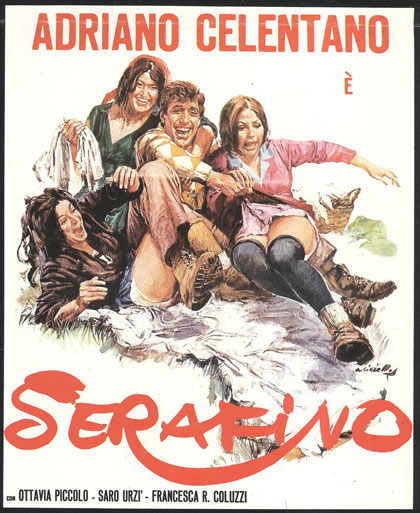
Meanwhile, imitating Sinatra, he formed the "Adriano Celetano Clan", consisting of singers, musicians, arrangers who since then have worked permanently for him. In 1968, Pietro Germi, as mentioned above in the chapter devoted to him, insisted upon having Celentano for the title role in SERAFINO, a rustic peasant comedy. In 1971, Alberto Lattuada starred him in BIANCO, ROSSO E... (WHITE, RED AND...) with Sophia Loren. In RUGANTINO (1973) by Pasquale Festa Campanile, he brought to the screen the musical comedy that Nino Manfredi had appeared in on stage.

Friday, January 13, 2012

12. Pietro Germi Vs. Moralism part four

From: COMEDY ITALIAN STYLE

by Ernesto G. Laura

The director returns to a popular world in SERAFINO, which is 1966 won first prize (ex-aequo) at the Moscow Film Festival. On a script written by Giovannetti, Benvenuti, De Bernardi and Pinelli, Germi tells a story about a small Ciociaro town of farmers and shepherds, cut off from the modern world. Most of all it is the portrait of Serafino, a country yokel, lumpish and uncouth but good at heart and very asute, who manages to extricate himself, amidst swindlers and swellheads, and to get along with unruffled serenity, veritable symbol of the pure, unspoiled popular soul. By no accident, of the people around him the only figure who is to a certain extent lovable and positive is Asmara, a young village prostitute, the mother of countless children (excellently portrayed by Francesca Romana Coluzzi). Of particular interest the dialogue, where for the first time slighting "bawdy" verbal expressions are used, typical of the way a peasant would speak. The film launched the acting career of a pop singer, Adriano Celetano, who will be further discussed in the last chapter, revealing in him outstanding qualities as a spontaneous and appealing actor.

At the time of his death, Germi was preparing AMICI MIEI (MY FRIENDS: 1975), which was then directed by Mario Monicelli with the utmost respect for the intentions and desires of the late director, so that while Monicelli appeared in the credit titles as the director, a notice was added with the words: "a film by Pietro Germi".

After Sicily, the Veneto and Lazio, now it was Tuscany which, from the time of Giovanni Boccaccio's classic novelle, has been the land of the practical joke, the sarcastic jibe, the sometimes even cruel prank. Five fifty-year old friends, distinguished professionals in life, are used to getting together from time to time to play sensational jokes in the most unimaginable places, often devised, planned, and carried out on a large scale. Life, however, cannot be brought to a halt byt his childish way of staying twenty when you are more than twice the age, and the death of one of them would end by giving them a glimpse of the bitter fact that the days of games and horseplay are over. Whimsical, bizarre, jocose, interrupted by frequent thrusts of grief and drama, AMICI MIEI (MY FRIENDS) blends the finest qualities of Germi and Monicelli in a satirical representation of penetrating depth. The five friends are Tognazzi, Philippe Noiret, Gastone Moschin, Adolfo Celi and Duilio Del Prete, while Bernard Blier plays the part of Righi, their chosen victim.