Monday, January 16, 2012

13. The "Second Wave" of Comedy Actors part one

From: COMEDY ITALIAN STYLE

by Ernesto G. Laura

In the decade, 1970-1980, a "second" wave of Italian-style comedy actors appeared on the scene, along with Sordi, Tognazzi, Manfredi and Gassman, who maintained their popularity.

Some of them already worked in films, even in leading roles, but had not had a real opportunity to rise from the ranks of qualified professionals to a star status around which a film could be built.

Such was the case of Johnny Dorelli (Giorgio Guidi, born in 1937, the son of a well-known pop singer of the '30s, Nino D'Aurelio). Small of stature with a good-natured disposition prone to smiles, Dorelli was launched into show business in America by the conductor, Percy Faith, and in the '50s often appeared there on television. Returning to Italy, he won several San Remo Song Festivals and from there won easy access to Italian television where he introduced the formula, common in America but at that time unknown in Italy, of the singer who was also an entertainer, hence able to carry the weight of a full show, establishing immediate contact with the audience. With all this, it was obvious that motion pictures would seek to exploit his gifts as a singer, as well as his immediately apparent merits as an actor, but in the beginning he was used in second-rate films or only as a singer. PANE E CIOCCOLATA (BREAD AND CHOCOLATE: 1974) by Franco Brusati, which has already been mentioned with regard to Nino Manfredi, and his extraordinary performance, revealed an unexpected Dorelli in the cameo role of an Italian industrialist who has fled to Switzerland for tax reasons and then commits suicide when his wife abandons him. The simplicity of manner, the good-heartedness, the smile that Dorelli had already identified with his "personage" here became the dramatic defense of a man who is sliding inexorably towards self-destruction.

The interest aroused by PANE E CIOCCOLATA (BREAD AND CHOCOLATE) enabled Dorelli to escape the rountine of second-rate films and seek a path of his own within Italian-style comedy. UNA SERA C'INCONTRAMMO... (ONE EVENING WE MET...: 1975) by Piero Schivazappa was based on the novel AMARE SIGNIFICA... by Italo Terzoli and Enrico Vaime (in the 1970s, after a long absence, the Italian humorous novel regained popularity: the new authors included Carlo Silva, Umberto Simonetta, Castellano and Pipolo, and the Terzoli-Vaime team). The main comical idea, with its overtones of bitterness, involved the passion of an enormously fat girl (German actress Fran Fullenwider) for a skinny little workman (Johnny Dorelli), a situation complicated by the fact that the girl, who was very possessive, was also a rich man's daughter. The Lombardy setting added flavor to the film both as scenery and in the use of an Italian idiom that was a blend of different dialects, both far removed from the usual Roman environment of Italian-style comedy.

Friday, January 13, 2012

12. Pietro Germi Vs. Moralism part four

From: COMEDY ITALIAN STYLE

by Ernesto G. Laura

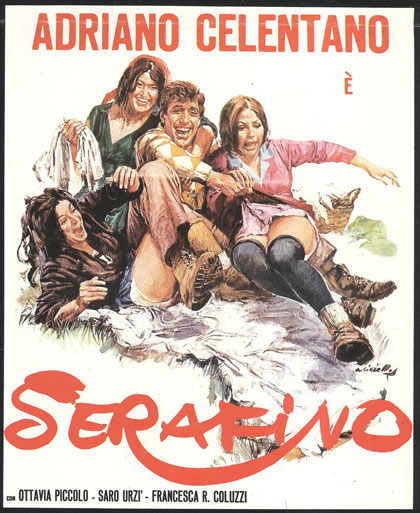
The director returns to a popular world in SERAFINO, which is 1966 won first prize (ex-aequo) at the Moscow Film Festival. On a script written by Giovannetti, Benvenuti, De Bernardi and Pinelli, Germi tells a story about a small Ciociaro town of farmers and shepherds, cut off from the modern world. Most of all it is the portrait of Serafino, a country yokel, lumpish and uncouth but good at heart and very asute, who manages to extricate himself, amidst swindlers and swellheads, and to get along with unruffled serenity, veritable symbol of the pure, unspoiled popular soul. By no accident, of the people around him the only figure who is to a certain extent lovable and positive is Asmara, a young village prostitute, the mother of countless children (excellently portrayed by Francesca Romana Coluzzi). Of particular interest the dialogue, where for the first time slighting "bawdy" verbal expressions are used, typical of the way a peasant would speak. The film launched the acting career of a pop singer, Adriano Celetano, who will be further discussed in the last chapter, revealing in him outstanding qualities as a spontaneous and appealing actor.

At the time of his death, Germi was preparing AMICI MIEI (MY FRIENDS: 1975), which was then directed by Mario Monicelli with the utmost respect for the intentions and desires of the late director, so that while Monicelli appeared in the credit titles as the director, a notice was added with the words: "a film by Pietro Germi".

After Sicily, the Veneto and Lazio, now it was Tuscany which, from the time of Giovanni Boccaccio's classic novelle, has been the land of the practical joke, the sarcastic jibe, the sometimes even cruel prank. Five fifty-year old friends, distinguished professionals in life, are used to getting together from time to time to play sensational jokes in the most unimaginable places, often devised, planned, and carried out on a large scale. Life, however, cannot be brought to a halt byt his childish way of staying twenty when you are more than twice the age, and the death of one of them would end by giving them a glimpse of the bitter fact that the days of games and horseplay are over. Whimsical, bizarre, jocose, interrupted by frequent thrusts of grief and drama, AMICI MIEI (MY FRIENDS) blends the finest qualities of Germi and Monicelli in a satirical representation of penetrating depth. The five friends are Tognazzi, Philippe Noiret, Gastone Moschin, Adolfo Celi and Duilio Del Prete, while Bernard Blier plays the part of Righi, their chosen victim.

Thursday, January 12, 2012

12. Pietro Germi Vs. Moralism part three

From: COMEDY ITALIAN STYLE

by Ernesto G. Laura

In 1966, Germi won the Gold Palm (ex-aequo) at the Cannes festival with SIGNORE E SIGNORI (LADIES AND GENTLEMEN), in which he moves his criticism of manners to the Veneto bourgeoisie, using the town of Treviso as his geographical and social setting. Veneto writer Luciano Vincenzoni collaborated closely with the director on the story and script (Age and Scarpelli helped with the latter), fitting together a mosaic teeming with figures, large and small, of a colorful human "bestiary", caught in the merry-go-round of hypocrisy which Germi attacks with a firm polemical thrust. A multitude of well-known actors moves through the film, each given a space of his own: from Alberto Lionello to Olga Villi, from Gigi Ballista and Gaston Moschin to Virna Lisi and Franco Fabrizi.

One gets, even so, the impression that Germi didn't preserve on screen everything he had observed and that the film, however amusing and well-constructed and however skillful the dialogue, offers a less definitive picture of that bourgeois society than it could have been, sometimes bordering on the caricature sketch, which is something less than satire.

L'IMMORALE (THE IMMORALIST: 1967) was polemical, starting from the title itself. Instead of the analysis of a provincial society, as in his other two comedies, the director (with the collaboration on the script of Alfredo Giannetti, Tullio Pinelli and Carlo Bernari) pauses to shed light on the paradoxical situation of a single character, a violinist who, with a certain seriousness of his own, takes up with other women aside from his wife, ends up having three homes and three families, children included, and is forced to run from one train to another to keep his different wives happy and also wearing himself out from the fulfillment of his marriage "duties", until he dies from a heart attack. Germi doesn't pass judgment but is interested in exploring the soul of this man, who from the outside would seem to be a kind of playboy but is capable, instead, of a very special and sincere kind of loving of his own. Ugo Tognazzi was the violinist, Stefania Sandrelli, Renee Longarini and Maria Grazia Carmassi his three women.

Wednesday, January 11, 2012

12. Pietro Germi Vs. Moralism part two

From: COMEDY ITALIAN STYLE

by Ernesto G. Laura

DIVORZIO ALL'ITALIANA (DIVORCE, ITALIAN STYLE: 1961), awarded an Oscar in 1963 for the best original story and script (written by Ennio De Concini, Alfredo Giannetti and the director himself), takes Germi back to Sicily, not however the Sicily of the mafia but rather of the high land-owning aristocracy. Since at that time divorce didn't exist in Italy and local society would not have tolerated cohabitation, Baron Fefe, in order to marry his enticing little cousin, Angela, must first of all get rid of his wife. At first, he fondles various kinds of perfect crimes in his imagination, then as an expert connoisseur of the rigid moralistic mentality of his world, gets the idea for a highly unique "Italian-style divorce": force his wife to commit adultery, catch her redhanded and then he would be authorized, according to a certain article of the penal code, at that time still in force, to kill her "for reasons of honor". To be sure, he would spend a few years in prison, with all the comforts a rich man could afford, but thanks to "good conduct" he would soon be released and able to wed the charming Angela. The story unfolds, agile and amusing, linking together minor and major figures, people and geographical and social backgrounds. Marcello Mastroianni is an utterly absurd Fefe, indolent, sly, bored, without a job or a serious worry in the world, the prototype of an impoverished and effete aristocracy which Germi eyes with the maliciousness of great satire, just as the arm of satire serves him to attack those aspects of the penal code which to the modern conscience seemed more than out-of-date.

Moral outrage was the mainspring of the director's second comedy of manners set in Sicily: SEDOTTA E ABBANDONATA (SEDUCED AND ABANDONED: 1964), written by Germi with Luchino Vincenzoni, Age and Scarpelli and centered entirely around the agitated figure of Vincenzo Ascalone, the father of family who even on his death bed is obsessed with defending the "family honor". A much more mature work than the previous one, with characters more deeply explored, developments more complex, it is to be considered one of the most successful products of Italian-style comedy and of Germi as a director, starring an actor who up to that moment had been relegated to secondary character roles, Saro Uzi, and Stefania Sandrelli, an actress whom Germi discovered and rightly supported: her aggressive and exuberant Agnese confirms the qualities that emerged in the Angela of her first film, DIVORZIO ALL'ITALIANA (DIVORCE, ITALIAN STYLE).

Monday, January 9, 2012

12. Pietro Germi Vs. Moralism part one

From: COMEDY ITALIAN STYLE


by Ernesto G. Laura


When in 1952 Pietro Germi brought to the screen one of the best-known French "pochades" of the Belle Epoque, LA PRESIDENTESSA (MME. LA PRESIDENTE), many people were shocked and perhaps even outraged. The Genoese director (1914-1975) had, in fact, made a name for himself with several films of vigorous dramatic impact and fervent social commitment, along the lines of a non-ideological Socialism of an humanitarian cast that enjoyed quite a tradition in Italy (think of the fiction of Edmondo De Amicis at the turn of the century). In 1949, IN NOME DELLA LEGGE (IN THE NAME OF THE LAW) had brought to the screen for the first time and with no holds barred the dangerous subject of the Mafia in Sicily; in 1952, IL CAMMINO DELLA SPERANZA (THE WAY OF HOPE) followed the journey of a group of poor people from the South towards the border to seek work abroad. A shy and private man, but actually, behind a screen of gruffness, warm in his affections, sympathetic to the poor and humble, prepared to fling himself courageously into the battles he felt were just, he created in films wonderfully human figures of workmen, of simple laborers, often played by himself. All at once in 1961, he changed genre and for the remaining years of his life became one of the foremost representatives of comedy. Actually, he had changed nothing but the accent. Germi was one of those directors who was concerned about communicating with the largest possible number of spectators. Comedy struck him at a certain moment as being more suited to that purpose, while maintaining the same human and social interests as before.

Friday, January 6, 2012

11. Comedy Dresses Up part five

From: COMEDY ITALIAN STYLE

by Ernesto G. Laura


Among the comedies in costume, set in other periods and other countries, the representation of characters and environments of old Russia was chosen by a sensitive director, Alberto Lattuada, capable of completely identifying himself with that world, uniting a sense of humor, a knowledge of the culture and a gift for recreating its particular flavor (through scenery, costumes, the style of acting).

IL CAPPOTTO (THE OVERCOAT: 1953) brought to the screen one of the finest novels by Nikolai Gogol, but contrary to the director's usually scrupulous attention to historical detail, he moved the story from the 19th century to the present day and, while avoiding any specific geographical indications, from Russia to Italy. Akakij Akakievich became Carmine De Carmine, the film was shot on location in the Lombardy city of Pavia. It is the story of a little man oppressed by the authorities. One day Carmine decides to put together the little money he owns to buy himself a new overcoat, which is so handsome that the modest tailor who made it shadows him to admire the effect it has on passers-by. But the coat is soon stolen and for Carmine nothing remains of the sole blessing that had made him happy for a day. Carmine dies and as a ghost has a much more lively time compared to his grey and monotonous existence; constantly appearing and reappearing in the life of the city mayor, his persecutor, the symbol of cynical and self-interested "power", he persuades him to mend his ways. The script-writers, including Cesare Zavattini who contributed many amusing gags, provided the director with a script respectful of the Gogol original but also full of new inventions. Stylistically, the film deliberately wavers between realism and the surreal fable, benefiting enormously from the presence of a comedian at that time famous for certain elements of "nonsense" introduced into the light theater revue and instead poorly exploited by motion pictures which up till then had humiliated his talents in farces of no importance: Renato Rascel. Placed in a specific psychological framework, Rascel endows his Carmine with a quality of suffering that is never over-stated and can also find expression in a sudden comic twist. Italian comedy, by combining Lattuada's narrative and dramatic talent and Rascel's gifts for humor, attains with IL CAPPOTTO (THE OVERCOAT) one of its highest and most ambitious achievements. (Lattuada would go on to direct CUORE DI CANE - A DOG'S HEART, which will be discussed in a later chapter).

Thursday, January 5, 2012

11. Comedy Dresses Up part four

From: COMEDY ITALIAN STYLE

by Ernesto G. Laura

FAUSTINA (1969), Luigi Magni's first film as a director, is to be sure given a modern setting but ancient Rome plays an important part. The main characters, in fact, are "tombaroli", that is those people who steal from Roman and Etruscan tombs, who are specialized in archeological plunder and then sell the precious finds to foreign collectors. The sudden appearance in that milieu of a young dreamer would captivate Faustina, the "tombarolo's" black wife, leading to a series of consequences to be explained mostly by that strange profession and the background of ruins where the characters live. Enzo Cerusico, an Italian better known in America than in Italy as a result of a number of television serials and appearances on Broadway, was the poetic inamorato, Vonetta McGee the young bride, Renzo Montagnani the coarse robber.

The satirical force of G.G. Belli's sonnets in Roman dialect seems to inform Magni's next film, NELL' ANNO DEL SIGNORE (IN THE YEAR OF OUR LORD...: 1969), it too appearing in the wake of RUGANTINO. The period and place are the same: Rome around 1825, identical the actor set against that historical background, Nino Manfredi, who is Cornacchia, a cobbler who pretends to be illiterate but is actually Pasquino, known all over Rome for his anti-papal invectives. The imaginary events are interwoven with a true historical episode, the execution of the conspirators of the Carboneria (a secret society from the time of the Risorgimento), Montanari and Targhini, which took place, as a plaque indicates even today, in Piazza del Popolo. Also appearing in the film were Ugo Tognazzi, in the role of the treacherous and shifty Cardinal Rivarola, and Alberto Sordi in that of a fanatical monk.

In 1970, Magni wrote and directed, less successfully but always on a high level of entertainment, SCIPIONE DETTO ANCHE L'AFRICANO (SCIPIO KNOWN ALSO AS THE AFRICAN), where the action was carried back to Imperial Rome in order to satirize the political intrigues of power at the time the Roman General was preparing to defeat Carthage. Along with Marcello Mastroianni in the title role, Magni used his brother, Ruggero Mastroianni, a well-known Italian film editor, Vittorio Gassman, Turi Ferro and Silvana Mangano.